

Headed by the Los Angeles County Department of Agriculture, the LA WMA is a collection of partner agencies working together to prevent the introduction, establishment and spread of invasive plant species, as well as monitoring, evaluation, and communicating conditions. In general, the goal is to restore healthy native ecosystems. The steering committee meets quarterly or as needed.
Events
The Cal-IPC Symposium 2026 is over, but if you attended, you can go back to the Whova symposium site, and view recordings of the sessions. These will be available until January 20, 2027. 
EDRR
Early Detection, Rapid Response is becoming a priority for land managers, so there are a lot of current efforts in catching and eliminating weeds before they become established. The Los Angeles County and Ventura County WMAs have teamed up to create EDRR target species. Observations are critical to this effort and therefore highly encouraged on iNaturalist, or even better, Calflora.org. Help on how to use Calflora’s Observer app can be found on this page, or at Calflora’s observer help page. Contact Rachel Burnap to submit proposed EDRR target species or find out more.
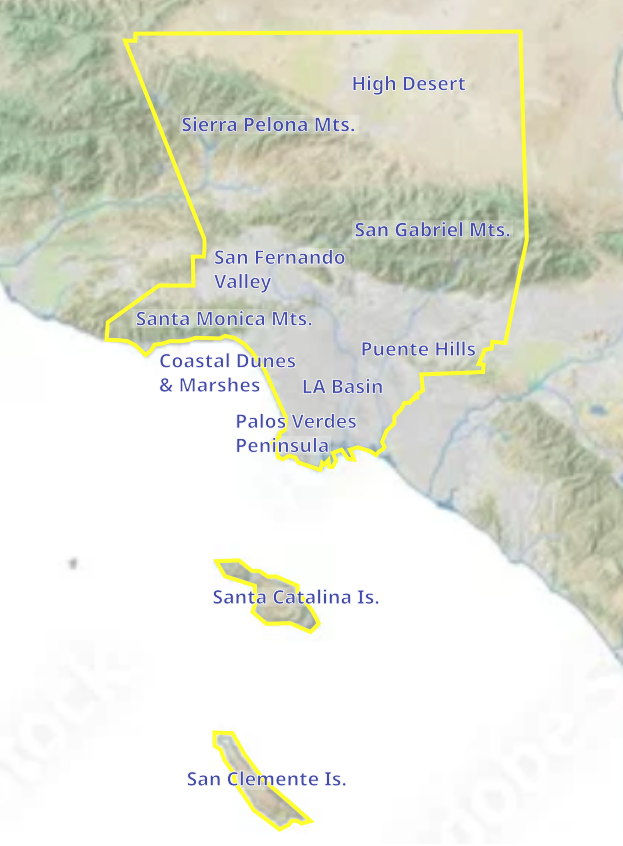
The variety of areas within LA County
Current Projects
The LA WMA is very diverse, ranging from high desert to high mountains to coastal marshland with many geographic borders. Here are some projects from around the county:
UCLA Stunt Ranch Santa Monica Mountains Reserve
The dominant non-native plants in this area include: Black Mustard (Brassica nigra), Bermuda buttercup (Oxalis), Maltese star-thistle (Centaurea melitensis), Bur Clover (Medicago polymorpha), Non-Native Oat (Avena sp.), and Scarlet Pimpernel (Anagallis arvensis).
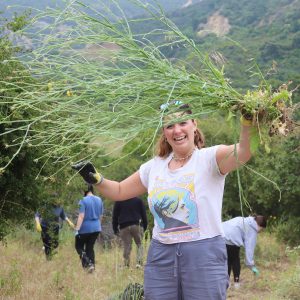
Another trophy weed at UCLA Stunt Ranch
Staff are restoring habitat through timed mowing and hand-pulling, and a newly established native plant nursery on site serves as the hub for sowing local seed and growing plants that will eventually be transplanted into designated restoration plots. Volunteers are central to this work. If you’d like to help restore habitat at Stunt Ranch, please reach out to site manager David Blake at dblake0405@g.ucla.edu.
Catalina Island Conservancy
The Catalina Island Conservancy’s Catalina Habitat Improvement and Restoration Program Invasive Plant Project (CHIRP-IPP) works to manage invasive plants across 48,000+ acre Catalina Island. The primary invasive plant challenge on Catalina is Mediterranean Broom (Genista linifolia). This species was introduced through horticulture in the early 1900s and since then has come to compose 5-10% of Catalina’s vegetation, particularly around the City of Avalon.
Early Detection Rapid Response (EDRR) is another major priority of CHIRP-IPP to further the protection of Catalina’s natural and cultural resources. Sightings reported via iNaturalist and Calflora are welcome. For further information regarding CHIRP-IPP please contact Aaron Kreisberg at akreisberg@catalinaconservancy.org. For information on volunteering with the Catalina Island Conservancy, contact volunteers@catalinaconservancy.org.
Palos Verdes Peninsula Land Conservancy (PVPLC)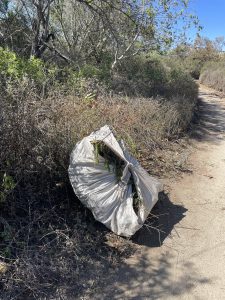
Recently, the main target has been Acacia (Acacia cyclops), though they are working on many other species. They are also working on Stinkwort (Dittrichia graveolens) on the military base in San Pedro with the US Navy. Many of the efforts at PVPLC revolve around protecting habitat for the critically endangered Palos Verdes Blue Butterfly. Volunteers are vital to the work at PVPLC. To find out more, visit the volunteer page here.
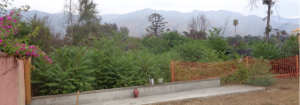
Ailanthus before
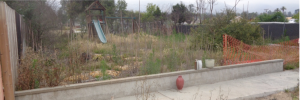
& After
Bill Neill
Bill is doing invasive mitigation all around the northern LA County and has recently been working with Ventura Land Trust on Castor Bean (Ricinus communis). He is also working north of Griffith Park in the San Fernando Valley on Tree of Heaven (Ailanthus altissima).
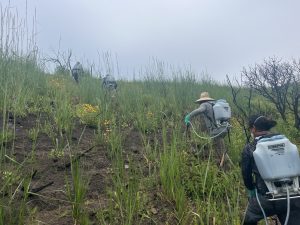
PESE treatments in Lower Tuna Canyon
Restoring Fire-Affected Hillsides in the Santa Monica Mountains
The Santa Monica Mountains Fund restoration team has been working to protect native habitats recovering from recent fires including the 2025 Palisades Fire and 2018 Woolsey Fire. Working in partnership with the National Park Service, a dedicated crew has been identifying and removing invasive plants that threaten the recovery of the region’s coastal sage scrub and other native plant communities. Wildfires create opportunities for invasive plants to spread rapidly, particularly along disturbed roadsides, drainage areas, and fire access routes. In and around Topanga State Park, our team has encountered aggressive infestations of invasive species such as tree tobacco (Nicotiana glauca), castor bean (Ricinus communis), fountain grass (Pennisetum setaceum), and Cape ivy (Delairea odorata).
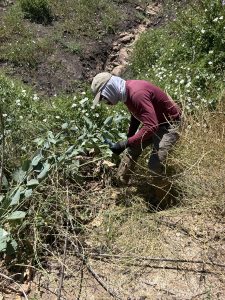
Cut-Stump treatments on Tree Tobacco
One recent success began with the discovery of a few invasive Harding grass (Phalaris aquatica) plants along a fire road. Further investigation revealed a much larger infestation extending across more than half an acre. Our team quickly developed and implemented a treatment strategy to prevent its continued spread into surrounding native habitat.
We’ve also discovered and treated some Early Detection and Rapid Response (EDRR) species like stinkwort (Dittrichia graveolens), woolly distaff thistle (Carthamus lanatus), and skeleton weed Chondrilla juncea). Persistent treatments have paid off and EDRR species have been reduced to only trace amounts. From surveying remote hillsides to carefully removing invasive plants, this work requires persistence, adaptability, and a strong understanding of the local ecosystem. Each infestation controlled represents another opportunity for native plants to recover and thrive. With continued support from our partners and volunteers, we can protect the biodiversity of the Santa Monica Mountains and help these landscapes recover from wildfire. Join in at the link below!
Outdoors Calendar – SANTA MONICA MOUNTAINS FUND
LACWMA Grants
The Grants from LA County Department of Agricultural Commissioner/Weights and Measures are closed for this cycle (2025 – 2028). Below are the grants that were funded.
Canyons to the Desert Resource Conservation District (CDRCD)
The CDRCD aims to combat high densities of non-native, highly noxious invasives in the Prime Desert Woodland Preserve in Lancaster. The primary target species are Prickly thistle/tumbleweeds (Salsola tragus), and Tamarisk (Tamarix spp.) The primary tactical approach for this project will be manual removal, and may incorporate nominal chemical/herbicide removal methods strictly on an as-needed basis.
Agriculture Access
This project is at Texas Canyon and Bouquet Canyon located in the Angeles National Forest. Tree of Heaven (Alianthus altissima), was an early invader into these watersheds, where it had quickly gained access along forest service roads, abandoned cabin sites, private properties boarding the forest lands, upland chaparral, and off-road vehicle sites. It will be treated following IPM protocols, targeting both the largest ‘parent trees’, (having the tallest, most mature leaf canopies) and newest ‘root sprouts’ (having the most active growing leaf canopies). Within this half-acre site, the project proposes to initially “suppress photosynthesis” by removing large parent canopies and root sprouts, and “blocking sunlight”. Long-term monitoring (6-months), will indicate the use of systemic herbicide Polaris (Imazapyr, 2.5%) if necessary.
Riparian Repairs
This project targets a quarter-acre Tree of Heaven (Ailanthus altissima) infestation on the east edge of Arroyo Seco. The Tree of Heaven plants will be basal-sprayed with Pathfinder II herbicide (triclopyr), and dead trees will be left standing. For several years, until regrowth stops, the site will be monitored for sucker growth, and sucker foliage sprayed with dilute imazapyr herbicide.
Descanso Gardens Foundation
This project targets the canyon on the western side of Descanso Gardens’ property, located in La Cañada Flintridge. It involves removal of invasive Hypericum canariense (St. John’s wort), while taking great care to sequester the seeds and eliminate all of the roots from the soil. It is a rigorous, non-chemical management strategy, that exceeds the capacity of Descanso’s staff. The project will utilize a multi-tiered mechanical and manual removal strategy. Funding will be used to secure an expanded and well-equipped labor force needed to scale this method across the canyon. The projected 10-year monitoring window will include quarterly evaluative surveys to track regrowth and native plant survival. Additionally, this will expand the native plant conservation footprint, and leverage the restoration timeline to engage the public, local schools, and environmental stakeholders in hands-on learning.
Council for Watershed Health
This is a long standing Arundo control program for the Upper LA River and development of a program for the San Gabriel River. This grant will help plan and manage the removal of approximately 80 acres of Arundo donax. Operations will combine manual hand-removal with targeted chemical control, utilizing selective, cut stump and occasional foliar applications of approved herbicides in accordance with landowner requirements. It completely avoids the active avian nesting season. Recognizing that Arundo requires persistent multi-year follow-up to achieve complete eradication, treated sites will be integrated into a multi-year monitoring and re-treatment schedule, with progress documented through ground-level photo monitoring and updates to a database using treatment update maps using spatial GIS layers. More information on this program can be found here.
Resources
Weed CUT
UC Agriculture and Natural Resources’ Weed Control User Tool provides a decision support tool that offers a reliable variety of treatment options. It gives you lots of choices and different ways to look up management practices.
UC Davis Weed Research and Information Center
This extensive site has weed management notes with write-ups detailing pest plants and a large resource database of articles regarding pest management.
LA County’s Best Management Practices for Vegetation Management
This thorough PDF is designed as a manual for prevention, eradication, and control of weeds. Additional information includes sample vegetation management plans.
Plant Right
This site helps steer people away from planting invasives. It is a good reference for gardeners and landscapers because it offers native alternatives to common invasives.
WMA General Contact:
Rachel Burnap, Los Angeles County Agricultural Weights and Measures RBurnap@acwm.lacounty.gov
site updated: 10/22/26