|
Spartina patens
|
|
|
|
Scientific name
|
Spartina patens
|
|
Additional name information:
|
(Aiton) Muhlenb.
|
|
Common name
|
salt-meadow cordgrass
|
|
Synonymous scientific names
|
none known
|
|
Closely related California natives
|
2
|
|
Closely related California non-natives:
|
3
|
|
Listed
|
CalEPPC List B,CDFA nl
|
|
By:
|
Allison Brown
|
|
Distribution
|
|
HOW DO I RECOGNIZE IT?
Distinctive features:
|
Salt-meadow cordgrass (Spartina
patens) is a long-lived grass one to four feet tall, with thin wiry stems
and tightly furled leaf blades, both of which are narrow (less than one-fifth of
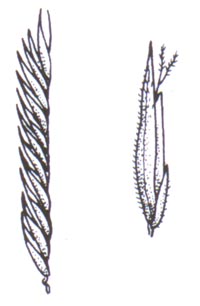
an inch) at the base. The inflorescence is open, composed of two to thirteen
spike-like branches, which emerge about sixty degrees from the central axis, the
lowest of which rarely overlaps (Hickman 1993). Other California coastal
cordgrass species have compact inflorescences with spike-like branches appressed
to the main axis. When plants are not blooming, the extremely narrow stem and
angled leaf distinguish this plant from other cordgrasses. Salt-meadow cordgrass
has a reddish purple base and no basal leaf sheath (Pattens, pers.
comm.).
åÊ
|
|
Description:
|
| Poaceae. Perennial grass. Rhizomes: if present, very thin, 0.2 in( |
|
Inflorescence: open, panicle-like, 0.4-4 in (2-9 cm) wide and 2-9 in (5-22 cm) long, with 2-13 spike-like branches spreading approximately 60 degrees from the central axis, each branch 0.4-3 in (1-8 cm) long and 0.08-0.2 in (2-4 mm) wide. Flower: spikelet 0.3-0.5 in (7-12 mm), with upper glume generally larger than lower glume, lemma 0.2-0.3 in (5-8 mm); keels rough-hairy at the tip (Hickman 1993). Seeds:
|
|
WHERE WOULD I FIND IT?
|
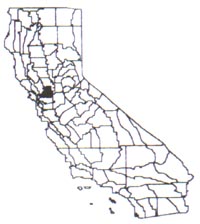
Salt-meadow cordgrass is found in coastal
salt marshes, sand dunes, and swales in California coastal counties from Santa
Barbara County north to Sonoma County (Calflora reports). In Benecia State Park
marsh, east of the Carquinez Strait, it occurs in the high salt marsh zone. It
can tolerate a wide range of salinity levels (Silander 1979). In salt marshes it
prefers moderately saline to brackish conditions in the middle to upper zone
(Chabreck and Condrey 1979). Salt-meadow cordgrass occurs with pickleweed
(Salicornia virginica), fleshy jaumea (Jaumea carnosa), salt
grass (Distichlis spicata) (Whitlow 1980), and sea lavender
(Limonium californica), as well as soft birdÛªs beak (Cordylanthus
mollis ssp. mollis) in the mid-upper salt marsh zone (Brown pers.
observation). It has invaded two additional Pacific Coast locations, Suislaw
Estuary on Cox Island in Oregon (Frenkel and Boss 1988) and Dosewallips State
Park, in Washington on the west side of Puget Sound (Frenkel 1987).
åÊ
|
|
WHERE DID IT COME FROM AND HOW IS IT SPREAD?
|
This cordgrass is native to the coastal
regions of the Gulf of Mexico and the Atlantic Ocean from Texas to Newfoundland
(Frenkel and Boss 1988). It may have been introduced as packing material in
association with unofficial plantings of eastern oysters (Crassotrea
virginica) in Oregon and Washington (Townsend 1896, Frenkel and Boss 1985).
The source of the population in California is unknown (Spicher, pers. comm.),
but it was first reported thirty-five years ago (Munz 1985). Dense, monotypic
circular patches form from a single genetic group, and proliferation and
reestablishment of colonies appears to be a function of seed dispersal (Frenkel
and Boss 1988). Reduced interspecific competition and the presence of barren or
disturbed areas near established colonies also facilitate invasion.
åÊ
|
|
WHAT PROBLEMS DOES IT CAUSE?
|
Since its introduction to Cox Island,
salt-meadow cordgrass has expanded exponentially, with new outlying patches
appearing in native vegetation (Frenkel and Boss 1988). As colonies expand, the
dense stems impede growth of native species, often collapsing onto adjacent
plants and smothering them (Frenkel and Boss 1988). Accretion coupled with
expansion of the cordgrass community ultimately may result in conversion of low
marsh to monotypic higher-elevation marsh. Dense mats of roots and rhizomes
occupying depths of up to eight inches (Clark 1994) may further impede
recolonization by native species. Seedlings can easily be overlooked and pose
additional problems for eradication.
In August 1997 the Benicia State Park marsh population of
salt-meadow cordgrass was localized in a 341 square foot area (Spicher and
Brown, pers. observation). Its proximity to the rare plant species
Cordylanthus mollis ssp. mollis, now federally listed,
warrants close attention, since current restoration efforts in this marsh may
alter conditions and favor expansion.
åÊ
|
|
HOW DOES IT GROW AND REPRODUCE?
|
| Radial expansion of cordgrass colonies is clonal. New plants arise from tillers, which produce abundant rhizomes and roots inside the patch perimeter. |
|
Tillers originating from a single plant can extend thirty-three feet (10 m) in one season (Silander 1979). Die-back generally occurs toward the center of the patch, possibly as a consequence of litter accumulation and associated anoxia (Goodwin and Williams 1961). Production of new colonies is thought to be by seed, although vegetative propagules may also facilitate colony formation (Frenkel and Boss 1988).
Salt-meadow cordgrass flowers from July through October. Seed heads form
within two to three years after seedling emergence (Pattens, pers. comm.) The
number of flowers is proportional to colony size (Frenkel and Boss 1988). Seed
production is highly variable and most likely dependent on pollen viability
(Frenkel, pers. comm.). In the marsh environment, selection seems to favor
genotypes with higher vegetative biomass and lower reproductive output (Silander
1979). In its native area, seeds mature in August or September and germinate in
April or May when conditions are warmer (Clark 1994).
|
|
HOW CAN I GET RID OF IT?
|
The best method for removing salt-meadow
cordgrass depends on the size of the population and the local conditions in
which it grows. Unfortunately, effective means for complete eradication of this
species have yet to be discovered. Since the plant often grows among other
species in tidally influenced marshes, great care is required in implementing
treatments.
åÊ
|
|
Physical control:
|
Manual/mechanical methods: Combined with
excavation of subterranean plant parts, hand pulling may be effective for small
patches. Seedlings are easily pulled as the root system is still shallow.
Clipping inflorescences and seed heads in small patches may help prevent
establishment of new colonies in adjacent areas, although existing clonal
patches will be unaffected. Mowing with a weed eater has been used with variable
success in Washington, but it must be done before plants set seed (May-June).
Solarization: Geotech fabric (tightly woven plastic mat) has
been effective in controlling salt-meadow cordgrass in areas with moderate tidal
range in Washington. Cloth is tucked into the ground beyond the tillering edge
with a shovel, then staked every ten feet (3 m). Rope or cable is criss-crossed
over the surface of the plastic and cinched to the stakes. Sand bands and bricks
are then placed onto the cloth to secure it (Clark 1994). The cloth should be
left in place for at least four growing seasons. This method is less effective
in lower elevations of marsh or in areas where drift wood accumulates (Pattens,
pers. comm.).
åÊ
|
|
Biological control:
|
Potential agents for this species have not
been investigated. Salt-meadow cordgrass establishment in barren, disturbed
areas may be impeded by planting another vigorously growing native species such
as pickleweed or saltgrass.
åÊ
|
|
Chemical control:
|
Wicking with 20 percent glyphosate (as
Rodeo) has been effective for portions of the Washington state population. In
California Rodeoå¨ must be applied by a certified pesticide applicator. While
this method may be appropriate for small peripheral stands and patches, problems
with calibration and excessive dripping have been reported (Moore, pers. comm.).
Backpack sprayers using 5 percent Rodeoå¨ may be an effective alternative for
larger populations.
åÊ
|