|
Retama monosperma
|
|
|
|
Scientific name
|
Retama monosperma
|
|
Additional name information:
|
Bailey
|
|
Common name
|
bridal veil broom
|
|
Synonymous scientific names
|
Genista monosperma, Spartium monosperma, Lygos monosperma
|
|
Closely related California natives
|
0
|
|
Closely related California non-natives:
|
3
|
|
Listed
|
CalEPPC Red Alert,CDFA nl
|
|
By:
|
Edie Jacobsen
|
|
Distribution
|
|
|
HOW DO I RECOGNIZE IT?
Distinctive features:
|
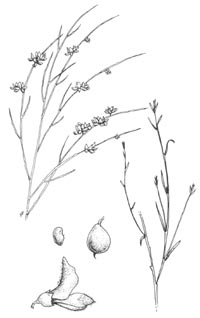
Bridal veil broom (Retama
monosperma) is a large shrub, ten feet tall or more, and when full grown
may be twenty feet across. Plants are gray-green, almost entirely leafless, with
slender branches drooping in weeping willow fashion. Young plants are usually
wispy, with a single stem and strong taproot. Young plants are most visible in
late summer and early fall when annual grasses are brown. Flowers are small,
white, and pea-like, appearing in short clusters from the stems. There is
usually one seed per pod, as indicated by its specific epithet. Spanish and
Scotch broom can be easily distinguished from this plant by their larger golden
yellow flowers. Spanish and Scotch broom also have more seeds per pod, four to
six and five to twelve, respectively.
åÊ
|
|
Description:
|
| Fabaceae. Tall ornamental woody shrub, to 10 ft (3 m) or more. Stems: unarmed, deciduous, slender grayish branches, nearly leafless; multi-stemmed, with branch diameters to 6 in (15 cm). Leaves: small, simple or rarely trifoliate, blades generally linear or linear-spatulate, silky. Inflorescence: flowers in short lateral racemes. Flowers: papilionaceous, white, fragrant; corolla silky, 0.4-0.6 in (10-17 mm); calyx 2-lipped 0.12-0.2 in (3-5 mm), with upper lip deeply 2-parted; style incurved, purple; keel cuspidate. Fruit: a legume; pod broadly oval, 1-2 seeded, dehiscent (Bailey 1933, Tutin et al. 1980). |
|
|
|
WHERE WOULD I FIND IT?
|
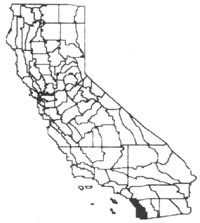
Bridal veil broom is known to occur in the
wild in California only on and adjacent to the Naval Ordnance Center, Pacific
Division, Fallbrook Annex in San Diego County. It occurs in granitic sandy loam
soils that are well drained. Associated plant communities are Diegan coastal
sage scrub, southern perennial grassland, and disturbed annual grassland. It
occurs mostly in disturbed annual grassland and disturbed Diegan coastal sage
scrub. The plant is suited to mediterranean climates on rocky slopes and sandy
banks. Planted as an ornamental species in south and central coastal California,
it may escape and become established elsewhere. It is unknown at this time if
other coastal habitats are threatened by this plant.
åÊ
|
|
WHERE DID IT COME FROM AND HOW IS IT SPREAD?
|
Bridal veil broom is native to the
Mediterranean region, chiefly Spain (Iberian Peninsula) and North Africa, where
it occurs on sandy soils near the coast and at border marshes. In its native
habitat it is a minor component of the coastal scrub community (Valdesi et al.
1987). It was cultivated as an ornamental in England as early as 1690 and has
been known to escape from cultivation there. There are a few records indicating
some cultivation of this plant in California since 1916, with one record from
San Diego in 1917 (McClintock, pers. comm.). A new invasive exotic in San Diego
County, it was first noted six years ago on the Naval Ordnance Center near the
city of Fallbrook. At that time it was growing in a few scattered patches
covering less than ten acres. When eradication measures were implemented in
1996, it occupied over 2,000 acres of the Annex. It is believed that this plant
escaped from a nearby nursery. Bridal veil broom spreads primarily by seed. Each
plant produces hundreds, and on larger plants thousands, of seeds. It appears
that ants and birds are the primary seed dispersers. At present, little is known
about its physiology and reproductive mechanisms.
|
|
WHAT PROBLEMS DOES IT CAUSE?
|
Bridal veil broom crowds out other
vegetation and can dominate grasslands and disturbed habitats. It is a threat to
the habitat of the federally endangered StephenÛªs kangaroo rat and the
threatened California gnatcatcher. As it becomes dominant in the landscape it
reduces the availability of vegetation to support sensitive species. No nesting
or foraging in and among these plants has been noted. There is no direct
evidence of allelopathy at this time. It is unknown whether this plant increases
fire risk. It has been in the natural landscape for such a short time that there
has been no large die-off of bridal veil broom or large build up of dead litter
on the ground in infested areas. However, its growth form of large, finely
branched limbs suggests that plants would burn readily.
|
|
HOW DOES IT GROW AND REPRODUCE?
|
Specific data regarding reproduction is unavailable. However, peak flowering is February-April, and plants have been observed flowering year round. Each plant produces large numbers of seed. Seeds are dispersed from the pods ballistically and then probably further dispersed by ants since they have elaiosomes (Bossard, pers. comm.) and rain runoff. Seeds remain viable in the soil for several years.
Bridal veil broom is a shrub, but detailed data regarding growth patterns is unavailable. Rapid growth is apparent during peak growth periods in spring and early summer. Annual growth rates are not known, but up to three feet (1 m) of growth has been noted within one year following cut-stump treatment. Young plants appear to grow one to two feet in the first year. The plant develops deep taproots. Bridal veil broom spreads readily and can resprout from the crown. Large stands of over 200 plants per acre have been noted. Where solid, homogeneous stands had not developed prior to eradication efforts, it appeared likely that they would develop in short order.
|
The plant appears to readily decompose upon cutting, and there is no direct evidence that it spreads by shoot fragments.
|
(click on photos to view larger image)
|
|
|
HOW CAN I GET RID OF IT?
|
A preferred method of control has not yet
been developed. This species is known in California from only one population,
and current eradication methods appear to be eliminating it there. Continued
monitoring and control efforts will be necessary until the seedbank is depleted.
Annual monitoring in summer following chemical treatment is recommended. Young
plants are most easily seen in summer, and sensitive species such as the
California gnatcatcher are not nesting at that time.
åÊ
|
|
Physical control:
|
Mechanical removal: Cutting stems off near
the ground with saws (brush saw and chain saw) or loppers will stress the plant.
Cut plants resprout vigorously, so cutting alone will not kill the plants
(Jacobsen, unpubl. data).
Prescribed burning: Burning has not been investigated for this
species, but may be useful for clearing the seedbank as for other brooms
(Bossard 1993).
åÊ
|
|
Biological control:
|
No USDA approved biological controls are
available. However, some plants were killed by gophers eating the roots. At this
time nothing is known about insects or fungi that could be used to control
bridal veil broom. No browsing by cattle has been noted.
åÊ
|
|
Chemical control:
|
Foliar application of glyphosate (as
Roundupå¨, 2.5 percent) will kill young plants less than about two feet tall.
Medium (up to six feet) and large (twenty feet in diameter) plants will be
stressed but not killed. Foliar application of triclopyr (as Garlon 4å¨, 10
percent) on young and medium-sized plants will achieve approximately 50 percent
kill. Basal bark application of triclopyr (as Garlon 4å¨, 25 percent) yielded the
same results but is less likely to impact non-target species.
A combination of cutting with chain saws and applying 10 percent
triclopyr (as Garlon 4å¨) solution to stump surfaces severely stressed the plants
but killed only 50 percent of them. A subsequent summer application achieved
approximately 90 percent mortality.
åÊ
|