|
Helichrysum petiolare
|
|
|
|
Scientific name
|
Helichrysum petiolare
|
|
Additional name information:
|
Hilliard & Burtt
|
|
Common name
|
helichrysum, licorice plant
|
|
Synonymous scientific names
|
Helichrysum petiolatum, Gnaphalium lanatum
|
|
Closely related California natives
|
0
|
|
Closely related California non-natives:
|
0
|
|
Listed
|
CalEPPC Red Alert,CDFA nl
|
|
By:
|
Jake Sigg
|
|
Distribution
|
|
|
HOW DO I RECOGNIZE IT?
Distinctive features:
|
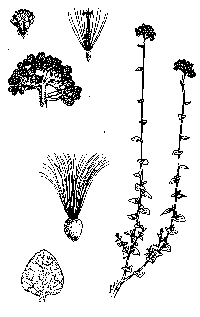
Helichrysum is a white-woolly,
sprawling, waist-high shrub that is capable of climbing. It has aromatic leaves
the size of a nickel or a quarter, densely matted on both surfaces with soft
white hairs, making the plant appear white. This whiteness makes it easy to spot
infestations from a distance. Its cream-colored flowers are in densely clustered
heads that resemble those of native everlastings and especially cudweeds
(Gnaphalium spp.), although native cudweeds are much smaller than this
plant.
åÊ
|
|
Description:
|
| Compositae. Perennial shrub to 3ft (1 m) high. Stems: to 3 ft (1 m) high. Leaves: aromatic, roundish-triangular 0.7-1 in (2-2.5 cm) with upper and lower surfaces covered in woolly hairs. Inflorescence: flowers densely clustered in 1-2 in (2.5-5 cm) heads that are corymbs. Flowers: cream-colored, discoid. |
|
|
|
WHERE WOULD I FIND IT?
|
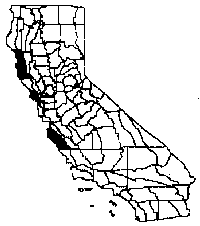
Helichrysum has been reported
outside cultivation in four locations in California, all within a few miles of
the ocean in Monterey, Marin, and Mendocino counties. The Monterey infestation
is in the Del Monte Forest, the two Marin populations are within the Golden Gate
National Recreation Area, and the Mendocino population is near Gualala (Howell
1969; Smith and Wheeler 1990). The plant invades coastal scrub communities, but
has the potential to invade coastal grasslands. It is sun-loving, and it is
unlikely to tolerate much shade.
The speciesÛª known tolerances (mild winters and summers)
indicate that it has the potential to invade along the California coast to a few
miles inland, especially the south and central coast. It thrives in either sandy
or heavy soil. Because it is a garden plant, special efforts should be made to
locate incipient infestations near human habitations in the coastal
belt.
åÊ
|
|
WHERE DID IT COME FROM AND HOW IS IT SPREAD?
|
Helichrysum petiolare is indigenous
to the coastal belt at the extreme southern tip of Africa. It was offered by
specialist nurseries in the 1960s, and present infestations are undoubtedly
garden escapes. Vegetative propagation may be an important means of spreading
because branches can root if in contact with the ground. Seeds are
wind-dispersed, but they generally do not carry long distances.
åÊ
|
|
WHAT PROBLEMS DOES IT CAUSE?
|
The Stinson Beach infestation in Golden Gate
National Recreation Area demonstrates that Helichrysum petiolare can
invade undisturbed sites, since it is penetrating an otherwise apparently
healthy, dense California sagebrush-coyote brush scrub. It forms a closed canopy
in places and displaces native plant species.
åÊ
|
|
HOW DOES IT GROW AND REPRODUCE?
|
Helichrysum petiolare spreads vegetatively and by seed. Flowering is in mid-summer, and abundant seed is produced by early autumn; seed longevity is not known. Its branches are lax and sprawling, and those touching ground will take root, hence vegetative propagation may be an important means of spread in California.
|
Seed germination, as with most Mediterranean-climate plants, is in fall after the first rains. Plants grow actively in spring and early summer; they flower in mid-summer followed by seed set, after which they are semi-dormant (Sunset 1988).
|
(click on photos to view larger image)
|
|
|
HOW CAN I GET RID OF IT?
|
There have been no reported efforts to
control Helichrysum petiolare. Small infestations are easily removed by
hand pulling. For large patches, it will be necessary to experiment with an
herbicidal application. The dense woolly hairs protecting the leaves may inhibit
absorption of many herbicides. A certified herbicide applicator should be able
to assist in selection of an effective surfactant. It is not known whether this
species is adapted to regenerate from seed or root crowns following
fire.
åÊ
|