|
Halogeton glomeratus
|
|
|
|
Scientific name
|
Halogeton glomeratus
|
|
Additional name information:
|
(M. Bieb) C. Meyer
|
|
Common name
|
halogeton
|
|
Synonymous scientific names
|
Anabasis glomerata
|
|
Closely related California natives
|
0
|
|
Closely related California non-natives:
|
0
|
|
Listed
|
CalEPPC Red Alert,CDFA A
|
|
By:
|
Steve Dewey
|
|
Distribution
|
|
|
HOW DO I RECOGNIZE IT?
Distinctive features:
|
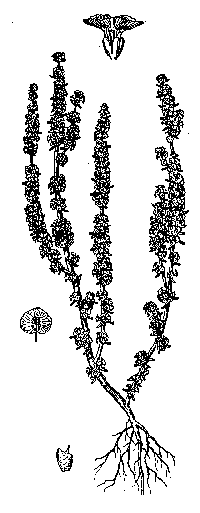
Halogeton is an annual herbaceous plant,
typically six to twelve inches tall, with short, fleshy, sausage-like leaves
less than half an inch long. One of its most distinctive features is the
conspicuous, soft, slender spine at the bluntly rounded tip of each leaf. Plants
are often bluish green in spring and early summer, turning yellow, salmon, pink,
purplish, or even reddish by late summer or early fall. Stems often turn pink or
red while leaves are still blue-green. Plants can resemble Russian thistle in
early stages of growth, but are distinguished easily by the unique leaf tips and
the presence of tiny, cotton-like hairs in the leaf axils.
åÊ
|
|
Description:
|
| Chenopodiaceae. Annual semi-succulent herb ranging from 2-18 in (5-45 cm) tall, and 2 to 18 in (5-45 cm) wide. Stems: main stems branch from the base, spreading at first, then bending upward to become erect, with numerous short lateral branches. Leaves: sausage-like, smooth, fleshy, 0.1 to 0.5 in (2-12 mm) long, positioned alternately on stems. Inflorescence: numerous inconspicuous flowers in compact clusters in leaf axils of upper stems. Flowers: two types, larger with 5 pale yellow or greenish yellow, fan-like membranous sepals (no petals), each about 0.08-0.12 in (2-3 mm) wide; smaller with tooth-like sepals (no petals). Both flower types generally have 2-5 stamens and 2 stigmas per flower. Halogeton also has two types of seeds. Fruits: wingless ÛÏbrownÛ (light tan-colored) seeds are produced in early summer, while winged ÛÏblackÛ (dark chocolate brown) seeds are produced in late summer (Welsh et al. 1987). |
|
|
|
WHERE WOULD I FIND IT?
|
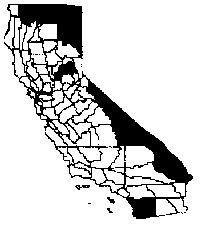
In 1980 halogeton was reported in Inyo, Kern, Lassen, Los
Angeles, Modoc, Mono, and Nevada counties in California. Today it can be found
throughout southern California and in all counties bordering Nevada. It has also
been reported from Siskiyou and San Diego counties. Halogeton is widely
distributed over millions of acres throughout at least eleven western states
from about 2,500 to 7,000 feet elevation. It is highly suited to the alkaline
and saline soils of the regionÛªs semi-arid high-desert environments, but it also
may be found on heavy clays, clay loams, sandy loams, and loamy sands. The
abundance of halogeton depends upon year-to-year precipitation, so outbreaks may
appear sporadically. Annual precipitation at most halogeton sites is from five
to thirteen inches (127-330 mm) (Cooke 1965).
Halogeton is found
mainly on disturbed arid sites in saltgrass, salt desert shrub, mixed desert
shrub, or pinyon-juniper plant communities. Annual weeds typically associated
with halogeton include cheat grass (Bromus tectorum) and Russian
thistle (Salsola tragus
). It is especially common along
roadsides, on the edges of alkaline flats, in livestock bedding or feeding
areas, in abandoned dryland farms and townsites, and around desert watering
sites (Pemberton 1986, Bellue 1951).
åÊ
|
|
WHERE DID IT COME FROM AND HOW IS IT SPREAD?
|
Halogeton is native to Eurasia or Siberia
and was introduced into the United States in northern Nevada in the early 1930s,
possibly for use in grazing experiments. The first herbarium specimen was
collected in 1934 in Nevada. It spread quickly into desert lands throughout
Nevada, Utah, California, and adjacent states (Cook and Stoddart 1953).
Halogeton can be dispersed by wind, water, animals, and human activity. Local
dispersal by wind is aided by winged bracts on the black seeds. Entire plants
can become tumbleweeds, driven by wind or catching on the undercarriage of
vehicles, distributing seeds for great distances. Whirlwinds or dust-devils can
transport dry stems with seeds up to two miles. Animals can spread large amounts
of seed great distances because the seeds are resistant to digestion (Whitson et
al. 1991, Dayton 1951, Stoddart et al. 1951). Halogeton seeds are rapidly spread
along roads by equipment, especially road graders (Cronin 1965).
åÊ
|
|
WHAT PROBLEMS DOES IT CAUSE?
|
Halogeton is not an extremely competitive
plant, but it can quickly invade disturbed or overgrazed sites, and it can
prevent reestablishment of desirable species. It is poisonous to livestock.
Sheep are especially prone to poisoning, although cattle also can be affected
(James et al. 1980). Leaves and stems are rich in a toxic substance called
sodium oxalate. Halogeton is readily consumed by hungry or thirsty livestock and
is responsible for thousands of livestock deaths. Signs of poisoning include
depression, weakness, reluctance to move, rapid and shallow respiration,
drooling, recumbency, coma, and death within two hours to several days after
ingestion (Bohmont et al. 1955). The best defense against poisoning is to keep
livestock away from infested sites, especially after drinking or following a
rain or snow storm (Burge 1950, Cook and Stoddart 1953).
åÊ
|
|
HOW DOES IT GROW AND REPRODUCE?
|
Reproduction of halogeton is exclusively by seed. Flowering typically begins in June. Fruiting and seed production are generally from July through October. Halogeton can produce seventy-five seeds per inch (35 seeds/cm) of stem, or 200 to 400 pounds of seeds per acre (222-449 kg/ha). More than 100,000 seeds can be produced on a single large plant. Two types of seeds are produced, which is important to the plantÛªs spread and persistence. Black seeds germinate during the first growing season after production; brown seeds can remain viable but dormant in the soil for ten years or more (Cronin and Williams 1966).
|
Halogeton takes advantage of infrequent desert precipitation by emerging quickly when soil moisture becomes available from February to mid-August. Plants grow rapidly and produce an abundant seed crop before frost ends the growing season in fall. Halogeton usually establishes first in disturbed sites, such as along road shoulders or livestock trails and bedding areas (Erickson et al. 1951).
|
(click on photos to view larger image)
|
|
|
HOW CAN I GET RID OF IT?
|
If eradication of small, isolated patches
of halogeton is the goal, it will be necessary to monitor infestations at least
once or twice each year to make sure no seedlings survive to produce seed. This
will have to be done for at least ten consecutive years, because halogeton seeds
can remain dormant but viable in the soil for that length of time. Controlling
extensive infestations will require elimination or reduction of the disturbance
that allowed halogeton to invade and simultaneous reestablishment of competitive
perennial grass, forb, and/or brush species (Fenley 1952).
åÊ
|
|
Physical control:
|
Manual/mechanical methods: Because
halogeton is a simple shallow-rooted annual, it can be controlled effectively by
tillage or pulling. Plants are easiest to control as seedlings or in early
vegetative growth. Plants not controlled until after flowering begins may
contain seeds and should be removed and destroyed to prevent reseeding. Periodic
mowing close to the soil surface can significantly reduce but not completely
prevent seed production. Surviving branches below the reach of mower blades will
continue to produce viable seeds.
Prescribed burning: Halogeton is not controlled effectively by
burning, and it is one of the first plants to reestablish following wildfire on
infested rangeland.
åÊ
|
|
Biological control:
|
Insects and fungi: A
stem-boring moth, Coleophora parthenica
, was introduced by the USDA into the United States for
possible control of halogeton, but it failed to establish. Other potential
biological control agents have been identified in Central Asia, but they have
not yet been developed and tested.
Grazing is not a control option because of the toxicity of the
plant.
åÊ
|
|
Chemical control:
|
Glyphosate (as Roundupå¨; 2 percent
solution) in a spot treatment on small infestations will kill emerged halogeton
plants if applied before the bloom stage. Repeat treatments will be necessary to
control any flushes emerging later in the season. Herbicides containing the
active ingredient metsulfuron (in Escortå¨ or Allyå¨) effectively control more
extensive infestations of halogeton in pastures and rangeland without causing
injury to desirable grasses. Colorado State University studies comparing various
rates of metsulfuron, dicamba (as Banvelå¨), and picloram (as Tordonå¨) reported
good initial control from each herbicide when applied in spring to small, one-
to three-inch (2.5-7.5 cm) tall halogeton plants. However, effects of many
treatments were temporary. Five months after application, control from
metsulfuron remained good to excellent (73-94 percent). However, dicamba
provided poor to good control (48-78 percent), and picloram treatments were
rated as poor (19-53 percent control) (Sebastian and Beck 1993).
åÊ
|