|
Erechtites spp.
|
|
|
|
Scientific name
|
Erechtites spp.
|
|
Additional name information:
|
E. glomerata (Poiret) DC.; E. minima (Poiret) DC.
|
|
Common name
|
cutleaf fireweed, cutleaf burnweed, New Zealand fireweed, Australian burnweed; Australian fireweed, little fireweed, coastal burnweed, Australian burnweed
|
|
Synonymous scientific names
|
Erechtites arguta, Senecio glomeratus, Senecio arguta; Erechtites prenanthoides, Senecio minimus, Senecio prenanthoides
|
|
Closely related California natives
|
0
|
|
Closely related California non-natives:
|
2
|
|
Listed
|
CalEPPC List B,CDFA nl
|
|
By:
|
Gavin Hoban,Marc C. Hoshovsky
|
|
Distribution
|
|
|
HOW DO I RECOGNIZE IT?
Distinctive features:
|
Both cutleaf fireweed (Erechtites
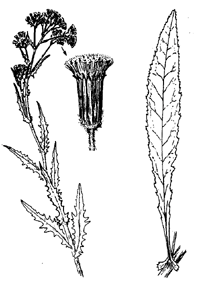
glomerata) and Australian fireweed (E. minima) are annual or short-lived perennials, four to eight feet in height. Flowers are dull yellow, arranged in cylindrical or oval-like groups to one foot across. Cutleaf fireweed has lance-shaped leaves that are sharply and unevenly toothed compared to the deeply pinnately lobed leaves of Australian fireweed (Hickman 1993, Robbins et al. 1941).
|
|
Description:
|
Erechtites
glomerata
Asteraceae. Annual herb or weak perennial. Stems: 0.3-6.6 ft
(10-200 cm) tall, erect from a deep, often branching taproot. Branches
ascending, thinly villous to tomentulose. Leaves: alternate, oblong-ovate to
lanceolate in outline, light gray-hairy, becoming somewhat smooth; 2.8-5.9 in
(7-15 cm); lower leaves petioled, deeply pinnately lobed or pinnatifid, villous
to tomen-tulose, becoming somewhat glabrous; upper leaves sessile, reduced, and
pinnately to irregularly toothed. Inflorescence: heads in terminal, somewhat
corymbose clusters or panicles; radial (discoid and salverform), involucre
0.2-0.3 in (5-8 mm) long, cylindrical, stalked. Phyllaries in 2 unequal series,
oblong, glabrous to thinly tomentulose, outer much shorter than inner, apices
acute. Flowers: two forms, outer pistillate, inner bisexual, corollas tubular,
pale or dull yellow. Fruit: achenes 0.04-0.08 in (1-2 mm) long, cylindrical,
ribbed; pappus 0.2 in (5 mm) long, white, composed of fine capillary bristles.
Flowers in California from April to October (Robbins et al. 1941).
E. glomerata (left), E. minima (right)
Erechtites
minima
Asteraceae. Annual herb or weak perennial. Habit and size
similar to Erechtites glomerata
, but subglabrous to obscurely puberulent.
Leaves: arachnoid (cobwebby) beneath, linear-lanceolate, evenly and finely
dentate, 2.8-7.9 in (7-20 cm), not lobed or pinnately cleft. Inflorescence:
large, to 30 cm broad. Flowers: pistillate, pappus 6-7 mm long (Robbins et al.
1941).
|
|
WHERE WOULD I FIND IT?
|
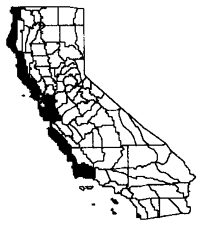
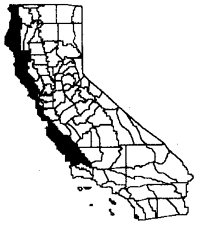
Both species occur occasionally along the
coast at low elevations (Erechtites species do not
now represent a major ecological threat to native plant communities on
CaliforniaÛªs north coast (Popenoe 1999). They invade areas following clearcut
logging operations, sometimes dominating overall plant cover, but other shrubs
and trees typically replace them in about five to ten years (Muldavin et al.
1981). Martin and Popenoe (1984) found buried seed of Erechtites to be
more abundant than seed of any other species in old-growth redwood forests of
Redwood National Park. Combined average seed density for the two species was 522
per square meter in old-growth blocks in the vicinity of recently harvested
clearcut second growth.
Erechites species can grow in a variety of climates.
Muldavin et al. (1981) found E. minima in clearcuts with compaction and
topsoil removal. They apparently are well suited to exploit fertile, freshly
disturbed ground, but are demanding of nutrients and are weak competitors.
Erechtites plants are uncommon in north coast vegetation types until
competing vegetation is removed, either mechanically or by fire. The plants are
also uncommon along roads where soil is compacted or topsoil has been
removed.
åÊ
|
|
WHERE DID IT COME FROM AND HOW IS IT SPREAD?
|
Both species are native to Australia and
New Zealand. Australian fireweed was naturalized in Humboldt County by 1918
(Robbins 1940). It has become naturalized on the West Coast only in southern
Oregon and California. Cutleaf fireweed was reported before 1941 in redwood
forests from Mendocino to Del Norte County (Robbins et al. 1941). Plants spread
by wind dispersal of seeds.
Erechtites species quickly dominate grasslands and
fields, and they are among the most serious plant pests in Channel Islands
National Park (Halvorson 1992).
åÊ
|
|
HOW DOES IT GROW AND REPRODUCE?
|
Little information is
available on growth and reproduction of either species. A related species,
Erechtites hieracifolia, is better known and may have similar characteristics.
In germination studies of Erecthtites
hieracifolia, a close relative of Australian fireweed, Baskin and Baskin
(1996) found that if conditions were not favorable for germination during the
late summer and early fall, about half of the seeds at maturity in September
became dormant. These seeds would not germinate under any test conditions,
whereas the other half of the seeds would germinate under only a narrow range of
test conditions. Australian fireweed flowers in July-September; cutleaf fireweed
flowers in June-August (Allen 1997).
Erechtites sp.
In germination studies
of Erechtites hieracifolia
, Baskin and Baskin (1996) found that half the seeds at maturity in
September would not germinate under any test condition, whereas others would
germinate under only a narrow range of conditions. Seeds appear to need minimal
temperatures to germinate, such as conditions in spring. Since 89 percent of
seeds were viable after eight years of burial, it appears that, although seeds
of this species are wind-dispersed, they also have the potential to form a
long-lived seedbank. Thus, soil disturbance at any time from May to September
could result in establishment of plants from seeds. Australian fireweed has been
reported to be facultatively mycorrhizal, which may explain its rapid invasion
capabilities in relatively arid grasslands on San Miguel and other coastal
California islands (Allen 1999).
Erechtites minima
|
On the Channel
Islands cutleaf fireweed apparently does not need disturbance to become
established (Halvorson 1992). Elliott et al. (1997) describe
Erechtites species as early successional and shade-intolerant.
Optimum conditions for E. hieracifolia
growth occurred at soil pH 5.3 to 5.5 (Stephenson and Recheigl 1991). At Point Reyes National Seashore, Australian fireweed commonly sends roots into the soil or into rotting wood from any stem that has been laid on the ground either by heavy rain or the weight of its long (to six feet) stems. Rooting stems continue to grow either vertically or horizontally. Many branch further to produce what looks like an entire flowering plant connected to its neighbor by one stem (Allen 1999).
|
(click on photos to view larger image)
|
Erechtites species tend to exhibit moderate
to rapid rates of infestation, particularly after fire. In less than one year of
initial establishment on San Miguel Island, Santa Barbara County, in 1984,
cutleaf fireweed spread to cover 173 acres (70 ha) with a maximum density of
3,237 plants per acre (8,800/ha). Within a year of the Vision fire in October
1995 at Point Reyes National Seashore, thick stands of Australian fireweed
dominated the burned areas where native bishop pine seedlings were
reestablishing. Over 1.2 million plants of Australian fireweed were removed in
1996 (Allen 1997).
|
|
HOW CAN I GET RID OF IT?
|
Monitoring three times a year is suggested
because of the large seedbank. Disturbance caused by removal efforts could
exacerbate the infestation.
åÊ
|
|
Physical control:
|
Manual methods: Channel Islands National
Park uses volunteers to manually remove cutleaf fireweed (Halvorson
1992).
åÊ
|
|
Biological control:
|
Insects and fungi: No biological control
agents have been approved by the USDA for use on Erechtites species.
Plant competition: Popenoe (1999) suggests that control
experiments might try to examine nutrient requirements and ability to compete.
Success might be possible by decreasing nitrogen availability by mulching with
sawdust, and sowing or planting natives to increase competition. Natives might
have a better chance of successful competition if they are innoculated with
mycorrhizae to increase their hold on available nutrient pools.
åÊ
|
|
Chemical control:
|
No information on chemical control of these
species is available. Herbicide effects may be similar to those for
Erechtites hieracifolia. Olney (1971) reported that atrazine gave
excellent control of E. hieracifolia, whereas diuron was ineffective.
Herbicides were applied as directed sprays to E. hieracifolia in
Hawaii. Diuron at 4 lb/acre gave excellent control for twenty weeks in both
trials. Linuron at 4 lb/acre gave comparable results (Higaki 1973). In
Indonesian tea plantations, three liters of glyphosate in 700 liters of water/ha
completely controlled Erechtites species (Sukasman 1979). Check with a
certified herbicide applicator to assess current chemical methods registered for
the habitat type at any site at which removal of E. minima or E.
glomerata is desired.
åÊ
|