|
Atriplex semibaccata
|
|
|
|
Scientific name
|
Atriplex semibaccata
|
|
Additional name information:
|
R. Brown
|
|
Common name
|
Australian saltbush
|
|
Synonymous scientific names
|
none known
|
|
Closely related California natives
|
31
|
|
Closely related California non-natives:
|
6
|
|
Listed
|
CalEPPC List A-2,CDFA nl
|
|
By:
|
Johathan Randall,Marc C. Hoshovsky
|
|
Distribution
|
|
|
HOW DO I RECOGNIZE IT?
Distinctive features:
|
Australian saltbush (Atriplex semibaccata) is a drought-tolerant, low-growing
shrub with silvery gray evergreen foliage and small red fruit. It forms a dense
groundcover that is fire retardant. The dense mat is less than one foot tall,
spreading up to six feet or more across.
|
|
Description:
|
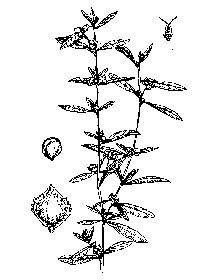
Chenopodiaceae. Perennial or subshrub
usually less than 13 in (33 cm) tall, from deep woody taproot; often
mounded. Stems: usually several stems that range from 1-5 ft (30-150 cm),
spreading on the ground or slightly ascending. Stems usually white-scaly
or becoming glabrous. Leaves: alternate, subsessile. Blade 0.32-1.2 in
(8-30 mm), oblong to narrowly elliptic, entire to
wavy-toothed, and often scaly, especially below blade. Inflorescence:
monoecious, pistillate flowers axillary, staminate flowers in terminal spikes,
each subtended by 2 bracts. Inflorescence ovate to almost diamond-shaped,
fleshy, reddish, net-veined, sub-entire. Fruit: with bracts approximately
0.2-0.3 in (4-8 mm), fused to the mid-section or slightly above, becoming thick
and fleshy in fruit. Seed: 0.06-0.08 in (1.5-2 mm) (Hickman 1993). |
|
|
|
WHERE WOULD I FIND IT?
|
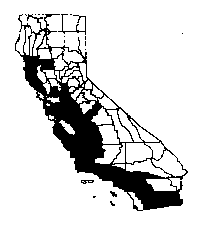
In California, Australian saltbush is found mostly in waste
places, shrubland, or woodland below 3,280 feet (1,000 m) elevation in the
Mojave and Sonoran deserts and arid parts of the South Coast, Central Coast, San
Francisco Bay Area, and Central Valley as far north as Glenn County. It also
inhabits coastal areas and coastal salt marshes from San Diego County to
Mendocino County. Australian saltbush is especially fond of heavy saline soils,
particularly areas that have been heavily grazed or disturbed. It is quick to
invade newly developed lands, roadsides, coastal marshes, and the margins of
cultivated fields (Halvorson et al. 1988, Hickman 1993).
|
|
WHERE DID IT COME FROM AND HOW IS IT SPREAD?
|
Australian saltbush is native to Australia and was originally
introduced to the United States as livestock forage. It was introduced to
California as forage in alkaline areas, starting in Tulare County in 1901. Seeds
were distributed throughout the state from there. By 1916 Australian saltbush
was abundant in San Diego. By 1940 it was common on the South Coast and found
infrequently inland to Imperial and San Bernardino counties and the Salinas
Valley (Robbins 1940).
Australian saltbush was promoted as a groundcover in
arid landscapes, for erosion control, and to attract birds. Birds eat the red,
berry-like fruits and may act as a means of dispersal (Sanders, pers. comm.).
The plant escaped cultivation and has become a common weed.
|
|
WHAT PROBLEMS DOES IT CAUSE?
|
As a ground-spreading plant, Australian
saltbush displaces native plants.
|
|
HOW DOES IT GROW AND REPRODUCE?
|
Australian saltbush reproduces by seed only. The plant
flowers from April to December. Male and female flowers are borne on the
same plant. Other similar Atriplex species are self-compatible and
wind-pollinated, suggesting this also may be true of this plant. Seeds are
produced in large numbers and are surrounded by fleshy bracts when mature
(Sanders, pers. comm. 1997 ). These fleshy bracts are attractive to fruit
eaters, which may help disperse the seeds. Seeds have been found in the
stomach contents of foxes and lizards on Santa Cruz Island (Valido and
Nogales 1994, Crooks 1994). Degree of persistence of seeds in soil and
germination conditions are unknown.
|
This low-spreading subshrub can form mats up to four feet
in diameter. It grows in full sun and requires little soil moisture (Plant
Advisor 1997). Australian saltbush is believed to be short-lived (two to
five years), but in favorable situations it may survive for up to ten
years (Sanders 1997). It is deep-rooted (Sunset 1996). Plants will survive
winter temperatures well below freezing (Plant Advisor 1997).
|
(click on photos to view larger image)
|
|
Seed germination can take place on saline soils, which
provides a competitive advantage over other native species (De Villiers et
al. 1995). Halvorson et al. (1988) reported that Australian saltbush was
one of the first species to colonize eroded lands on Santa Barbara Island.
|
|
|
HOW CAN I GET RID OF IT?
|
|
|
Physical control:
|
Manual methods: Australian saltbush is easy to control by hand
pulling because of its diminutive size. If it is pulled before it bears seeds,
it can be effectively controlled, but any residual seed pool will remain to
propagate the local population.
Prescribed burning: The effectiveness of
burning as a control method is not known.
|
|
Biological control:
|
Although the subject has not been researched in detail, it has been observed that the larvae from pygmy blue butterflies (Brephidium exile) feed on the foliage (Sanders, pers. comm.).
|
|
Chemical control:
|
Chemical control of Australian saltbush has
not been reported, although chemicals that control similar species, such as
kochia (Kochia scoparia) and Russian thistle (Salsola tragus), likely will work
on this saltbush. Russian thistle can be controlled with dicamba, 2,4-D, and
picloram plus 2,4-D at 1-1.5 fl oz/acre + 0.75 pt/acre. Picloram is currently
not registered in California. Kochia can also be controlled with dicamba plus
MCPA amine at label strengths. 2,4-D at 1.0 pt/acre gives good kochia control,
but good spray coverage is essential because 2,4-D does not translocate readily
in kochia. Treatment should be to plants less than three inches tall or large
spray volumes should be used to penetrate the kochia foliage. The esters of
2,4-D generally are more effective than the amines for both weeds. MCPA is not
as effective as 2,4-D in controlling either weed. However, MCPA at 1.0 pt/acre
will control small kochia plants. Picloram is not effective on kochia; but
control is good when combined with 2,4-D ester at 0.75 pt/acre (North Dakota
State University Extension Service 1998).
åÊ
|