Spartium junceum
|
|
|
|
Scientific name
|
Spartium junceum
|
|
Additional name information:
|
L.
|
|
Common name
|
Spanish broom, gorse, weaverÛªs broom
|
|
Synonymous scientific names
|
none known
|
|
Closely related California natives
|
0
|
|
Closely related California non-natives:
|
1
|
|
Listed
|
CalEPPC List B,CDFA nl
|
|
By:
|
Erik Nilsen
|
|
Distribution
|
Distribution:
|
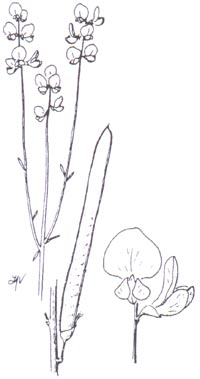
HOW DO I RECOGNIZE IT?
Distinctive features:
|
Spanish broom (Spartium junceum)
is a perennial shrub more than head high, with cylindrical rush-like branches,
green when young, turning brown as branches mature. Leaves are about half an
inch long, entire, and elongated to lance-shaped. Leaves are present on the
plant from February to early June, so this plant is leafless most of the year.
Large (an inch or more), light yellow, pea-like flowers are prominently
displayed on terminal racemes of outer canopy branches in late spring. Pods are
abundant and dark brown when mature. Pods split when dry, and the two halves of
the pod twist into a spiral shape, dropping the seeds.
åÊ
|
|
Description:
|
| Fabaceae. Shrub to small tree to 10-15 ft (3-5 m) in height. Stems: cylindrical green stems resemble rush stems (large central spongy pith) when young; mature into woody branches with bark, leading to development of one to several trunks. Leaves: small |
|
|
|
WHERE WOULD I FIND IT?
|
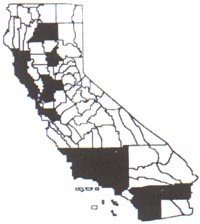
In California Spanish broom is found in
North Coast counties, the San Francisco Bay region, the Sacramento Valley,
through South Coast counties to the Mexican border, in the western Transverse
Ranges, and the Channel Islands. It is common in disturbed places, particularly
eroding slopes, river banks, road cuts, and abandoned or disturbed lands, and
can colonize post-burn chaparral and soft chaparral sites.
åÊ
|
|
WHERE DID IT COME FROM AND HOW IS IT SPREAD?
|
Spanish broom is native to the southern
Mediterranean region of Europe, including Spain, Morocco, the Canary Islands,
Madeira, and the Azores (Hickman, 1993). It was introduced into the California
ornamental trade in 1848 in San Francisco (Butterfield 1964). Beginning in the
late 1930s, Spanish broom was planted along mountain highways in southern
California (Hellmers and Ashby 1958). In 1949 Spartium junceum had established
naturalized populations in Marin County (Howell 1949). This species spreads by
abundantly, producing seeds that are transported by any type of erosion or by
rain wash.
åÊ
|
|
WHAT PROBLEMS DOES IT CAUSE?
|
Spanish broom rapidly colonizes disturbed
habitats and develops thick shrub communities that prevent colonization by
native soft or hard chaparral species. Plants grow to more than head height and
form a tangle containing a large amount of dead wood. Mature stands of Spanish
broom should be considered a fire hazard during the dry season. It is poor
forage for native wildlife.
åÊ
|
|
HOW DOES IT GROW AND REPRODUCE?
|
(click on photos to view larger image)
|
Spanish broom reproduces by seed after two to three years of growth. Flowers are pollinated by bees and produced in late March to early April. Pods mature and dehisce in late May through early June. Each inflorescence produces ten to fifteen pods containing approximately fifteen seeds each. One plant can easily produce 7,000 to 10,000 seed in one season. Seeds fall near the plant and are subsequently moved by erosion, rain wash, and possibly ants. Seed viability is at least five years, suggesting that a significant seedbank is present
|
|
in these stands. No research has been conducted on this plantÛªs seedbank, seed germination, or seedling recruitment.
Shoots of Spanish broom are initiated in late winter and early spring, but most rapid growth occurs in May. Shoots elongate quickly and produce leaves with long internodes. The shoots harden off in late spring and leaves drop. Photosynthesis by stems occurs all year. Although the leaves have twice the photosynthetic rate of stems (Nilsen et al. 1993), photosynthesis in stems provides most of the whole plant carbon gain because of their longer life span and larger surface area (Nilsen and Bao, 1990). Spanish broom flowers are popular in the ornamental trade and are used for yellow dye. Stems are used for fibers, which accounts for one of its common names, weaverÛªs broom. This species is also an effective stem sprouter.
|
|
HOW CAN I GET RID OF IT?
|
Information about eradicating Spanish broom is meager because
there has been little experimentation with this species compared with that for
Scotch broom (Cytisus scoparius) or French broom (Genista
monspessulana). Evaluation of the following mechanisms of renewal is
therefore based on the biology of the species rather than on information derived
from controlled experiments.
It is likely that the success of any control method will vary
with topography, soil chemistry, and climate, age and density of plants in the
stand, and the availability of human and technical resources. Since a large and
persistent seedbank is predicted from reproductive characteristics, rapid
regrowth of the stand is likely following fire or mechanical removal of
above-ground plant parts.
A comprehensive monitoring of control effectiveness is critical
because there is no scientifically based knowledge about control of Spanish
broom. Experimental manipulations should be monitored at least annually. Each
monitoring visit should determine the number of new plants and the size or age
distribution of the recovering population. Significant attention should be
placed on the proportion of new individuals coming from the seedbank or
resprouting from old plants. Monitoring should continue for at least five years
following control treatment.
åÊ
|
|
Physical control:
|
Manual/mechanical methods: Hand pulling of Spanish broom plants
will be practical when the stand is one to four years old. When plants are small
enough, pulling should be an effective mechanism of control as long as roots are
removed and follow-up treatment of seedlings is done. The optimal season for
pulling may be July-September when plants are already experiencing water stress
(Nilsen and Karpa 1994). When plants have matured to small tree size, they are
not amenable to pulling technology such as the weed wrench.
Brush hogs: Use of these machines is not likely to be effective
for several reasons. Many of the sites where Spanish broom has invaded are steep
slopes that may be difficult to traverse with a brush hog. The trunks of Spanish
broom also rapidly increase to a size outside the range of effectiveness for
this technology. Because of their twisting motion, brush hogs are more effective
in reducing resprouting than is saw cutting, but resprouting should be expected
following cutting by brush hog.
Saw cutting: This method would remove individuals in more mature
stands when the bases of plants are too large for pulling or for brush hog
removal. However, the clean cut from a saw will allow for maximum resprouting.
Spanish broom has a great facility for resprouting from a saw cut even when the
cut is close to the ground. Among all mechanical methods, saw cutting is the
least likely to be effective in preventing resprouting. In general,
manual/mechanical removal may be effective only when Spanish broom populations
are very young.
Prescribed burning: After low-temperature fires Spanish broom
will be able to resprout vigorously from trunk bases and stem meristems.
However, a hot fire that kills all above-ground stems and burns hot and close to
the ground will completely kill standing individuals and most likely remove some
of the seedbank. Seeds of this species are similar in structure to those of
Scotch broom (Cytisus scoparius). In heterogeneous or low-temperature
fires Scotch broom seedbanks were not effectively reduced. Under similar fire
conditions it is unlikely that fire will effectively reduce seedbank
regeneration of Spanish broom.
åÊ
|
|
Biological control:
|
There are no USDA approved biological
control agents for Spanish broom. In greenhouse situations plants are
susceptible to mealy bugs and show significant evidence of viral depression of
growth.
åÊ
|
|
Chemical control:
|
Spanish broom is sensitive to applied pesticides. In greenhouse
situations only mild pesticides can be used without detrimentally affecting the
plants. It is highly likely that application of chemicals such as glyphosate or
triclopyr will drastically reduce population size. The ramifications of applying
herbicides to a plant community must be carefully considered, because effects on
non-target species are likely, especially when foliage spray methods are
used.
A particularly effective control combination may be saw cutting
followed by an application of 3 percent glyphosate (as Roundupå¨) to cut stems.
This would remove above-ground plant parts to let light in for other species and
also kill the root system, preventing root sprouting. However, if a substantial
seedbank of Spanish broom already exists, the described combination will work
effectively only if seedlings are also removed for several years, either by hand
or by chemical treatments.
åÊ
|