|
Spartina densiflora
|
|
|
|
Scientific name
|
Spartina densiflora
|
|
Additional name information:
|
Brongn.
|
|
Common name
|
dense-flowered cordgrass
|
|
Synonymous scientific names
|
none known
|
|
Closely related California natives
|
2
|
|
Closely related California non-natives:
|
3
|
|
Listed
|
CalEPPC Red Alert,CDFA nl
|
|
By:
|
Phyllis Faber
|
|
Distribution
|
|
HOW DO I RECOGNIZE IT?
Distinctive features:
|
Dense-flowered cordgrass (Spartina
densiflora) is a perennial cordgrass distinguished from the native
cordgrass growing in West Coast coastal salt marshes by its grayish foliage,
narrower leaf blades, dense, compact growth form (giving the plant the
appearance of growing in distinct clumps), and earlier bloom period (up to a
month earlier than native cordgrass).
åÊ
|
|
Description:
|
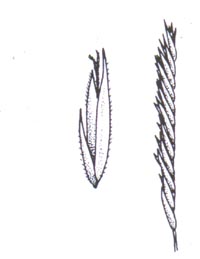
| Poaceae. Perennial cordgrass. If present, rhizomes short and stout, >0.4 in (10 mm) wide. Stems cespitose, 10-60 in (2.7-15 dm) long, slender with firm internodes. Leaves: blades 0.45-17 in (12-43 cm), generally inrolled when fresh, with ridges |
|
on upper surfaces. Inflorescence: spike from 2.4-11 in (6-30 cm), 0.15-0.46 in (4-12 mm) wide, compact; 2-20 branches, overlapping, appressed, 0.4-4.1 in (1-11 cm), 2.5-6 mm wide. Flower spikelet 0.3-0.55 in (8-14 mm), glume and lemma keels have short, sharp bristles at least near tip; lower glume 0.15-0.3 in (4-7 mm), upper glume 0.3-0.55 in ( 8-14 mm), lemma 0.28-0.35 (7-9 mm).
|
|
WHERE WOULD I FIND IT?
|
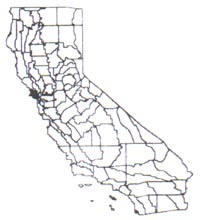
Dense-flowered cordgrass is found along the
central and northern California coast, particularly in Humboldt Bay salt marshes
and Corte Madera Creek in Marin County. Eicher (1987) found it to be distributed between 5.7 and 8.4 feet MLLW(mean low low water) (or 1.7 to 2.6 meters) at Humboldt Bay.
åÊ
|
|
WHERE DID IT COME FROM AND HOW IS IT SPREAD?
|
This species was introduced in the 1800s
from Chile by lumber ships that emptied their ballast water into Humboldt Bay
when loading north coast lumber bound for Chile (Spicher and Josselyn 1985).
Until 1984, when it was recognized as a distinct and exotic taxon, it had been
misidentified as a northern form of the native Spartina foliosa. It is
the dominant vegetation growing between lower and higher elevational populations
of pickleweed (Salicornia sp.). It was introduced into a marsh
restoration project at Creekside Park in Marin County by a landscape architect.
It appears to have traveled across San Francisco Bay to Richmond, where it grows
in clumps in parts of East Bay Regional Park.
åÊ
|
|
WHAT PROBLEMS DOES IT CAUSE?
|
Dense-flowered cordgrass grows at a
slightly higher elevation than native cordgrass and thus competes and replaces
native plants such as Frankenia salina, Limonium californicum,
and Jaumea carnosa in the middle to high tidal zone.
åÊ
|
|
HOW DOES IT GROW AND REPRODUCE?
|
| Spartina densiflora reproduces by seed and also expands vegetatively. It appears to spread by seed. Once established, a caespitose |
|
compact clump of cordgrass forms, with many leaves and inflorescences. Over a period of several years a single clump can expand to a meter or more in diameter (Barnhart et al. 1992).
|
|
HOW CAN I GET RID OF IT?
|
Little work has been done on techniques for
removal of this cordgrass, but methods used to control and eliminate
Spartina alterniflora should be effective on S.
densiflora.
åÊ
|