|
Spartina anglica
|
|
|
|
Scientific name
|
Spartina anglica
|
|
Additional name information:
|
Lois.
|
|
Common name
|
common cordgrass
|
|
Synonymous scientific names
|
none known
|
|
Closely related California natives
|
2
|
|
Closely related California non-natives:
|
3
|
|
Listed
|
CalEPPC Red Alert,CDFA nl
|
|
By:
|
Carla Bossard,Carri Benefield
|
|
Distribution
|
|
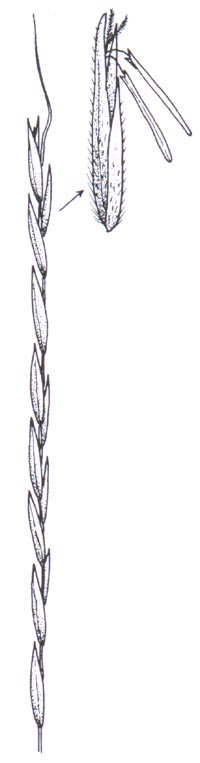
HOW DO I RECOGNIZE IT?
Distinctive features:
|
Common cordgrass (Spartina anglica)
is a perennial, spreading grass from one foot tall in spring to six or even
eight feet tall in fall. It grows naturally only in intertidal estuarine
habitats; often in large, nearly monospecific stands in coastal or bayside
marshes. It forms dense clumps, compared to the more open clumps of smooth
cordgrass (S. alterniflora). Common cordgrass stems are hollow in cross
section, round, and about half the diameter of smooth cordgrass. Leaves are
hairless, and leaf tips are sharply pointed. Young, healthy green shoots and
leaf sheaths are often streaked with red or purple just below the sediment
surface. Common cordgrass also has rows of hairs where the leaf meets the stem
(ligules) that are up to a third of an inch long, compared to the less than
one-fifth-inch length of smooth cordgrass ligules.
åÊ
|
|
Description:
|
Poaceae. Perennial grass. (See Spartina
alterniflora description above for differences). Rhizomes: 1/4-1/8 in (4-7 mm)
wide, fleshy, whitish. Stems: typically 100 years (Stiller and Denton 1995). |
|
åÊ
|
|
WHERE WOULD I FIND IT?
|
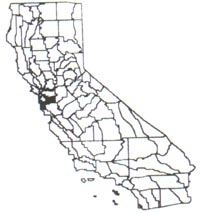
Common cordgrass is found in coastal salt
marshes, mud flats, and estuarine habitats similar to that of Spartina
alterniflora in California coastal counties. In California it is currently
found only in South San Francisco Bay.
åÊ
|
|
WHERE DID IT COME FROM AND HOW IS IT SPREAD?
|
Common cordgrass is a fertile hybrid between
Spartina maritima (a British species) and smooth cordgrass (S.
alterniflora). This hybrid was introduced into Washington in 1967 at Skagit
Salt Marsh and dispersed down Puget Sound. It may have dispersed to California
with south-flowing ocean currents, but this has not been established.
Common cordgrass seeds are spread by wind and water currents,
but can also spread vegetatively by rhizomes and fragments that break off and
move downstream.
åÊ
|
|
WHAT PROBLEMS DOES IT CAUSE?
|
This cordgrass, like other non-native
species of Spartina, traps sediment, builds marshes from the edge out,
and overgrows native vegetation. It alters the course of succession and produces
a monospecific stand that has much less value for wildlife than the native marsh
flora. It is believed that common cordgrass caused the dieback of the native
S. maritima in the United Kingdom (Doody 1984).
åÊ
|
|
HOW DOES IT GROW AND REPRODUCE?
|
| Common cordgrass flowers usually after one to two years, in late July-September. It has many inflorescences. Ripe seeds fall from October-January. Seeds |
|
germinate in February-May. Common cordgrass has been successful as a result of its rapid rate of growth, high fecundity, and aggressive colonization pattern. Seeds are an important source of invasion, but vegetative fragments may spread year round to enlarge the population locally (Benham 1990).
|
|
HOW CAN I GET RID OF IT?
|
Research has not been conducted on removal of common cordgrass,
but recommendations for removal of smooth cordgrass Spartina
alterniflora should be effective.
åÊ
|