|
Schismus spp.
|
|
|
|
Scientific name
|
Schismus spp.
|
|
Additional name information:
|
S. arabicus Nees , S. barbatus (L.) Thell.
|
|
Common name
|
Mediterranean grass, Arabian schismus, schismus, split grass
|
|
Synonymous scientific names
|
Festuca barbata (for S. barbatus)
|
|
Closely related California natives
|
0
|
|
Closely related California non-natives:
|
0
|
|
Listed
|
CalEPPC List B,CDFA nl
|
|
By:
|
Matthew Brooks
|
|
Distribution
|
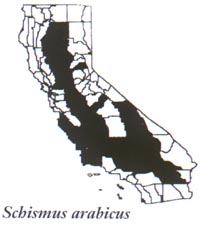
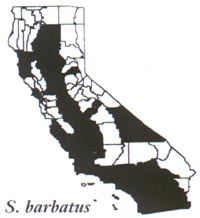
Schismus barbatus and S. arabicus are so
genetically and morphologically similar (Faruqui and Quarish 1979, Faruqui 1981,
Bor 1968), with similar geographic ranges and habitats in California (Hickman
1993), that they are treated together here.
|
HOW DO I RECOGNIZE IT?
Distinctive features:
|
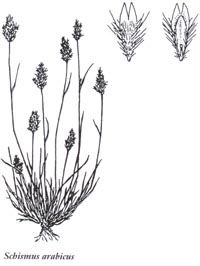
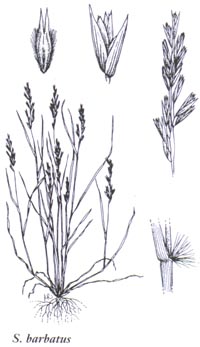
Mediterranean grass (Schismus
barbatus or S. arabicus) is a small, tufted annual grass with
erect or spreading, green, smooth culms to eight inches, often with brown nodes.
Individual plants can remain rooted and upright for up to two years following
death, but eventually detach at ground level and blow across the ground like a
tumbleweed, falling apart in the process. Mediterranean grass is most common in
the spaces between shrubs, often producing a carpet of green that turns purplish
at maturity and fades to a light straw color soon after death.
åÊ
|
|
Description:
|
Poaceae. Annual grass
with green culms that ascend or spread to 20 cm. Leaves: usually inrolled;
smooth except near the orifice where there is a ring of rigid hairs to 0.1
in (3 mm); blade
|
|
2-lobed apex;
palea shorter or as long as lemma; awnless. Seed: roundish, translucent, loosely
bounded by palea and lemma; embryo to half the length of the caryopsis.
Description adapted from Californian (Hickman 1993), Eurasian (Bor 1968, Tutin
et al. 1980), and worldwide (Conert and Turpe 1974) treatments of the species.
Spikelet morphology is
used to distinguish between Schismus arabicus and S. bar-batus. In S.
arabicus the apical lobes of the lemma gradually taper to sharp, narrow
points and are 30 to 50 percent of the total length of the lemma, whereas
in S. barbatus the lobes are wider and have broadly pointed to rounded
points that are 15 to 25 percent of the total length of the lemmas. The
lowest floret in the spikelet should be examined, because the morphology
of the lobes on the lemma becomes highly variable in higher florets. In S.
arabicus the palea does not generally extend beyond the base of the
fissure on the lemma, whereas in S. barbatus the palea extends beyond the
base of the fissure and may be |
|
as
long as the lemma lobes. The length of the glumes in the terminal spikelet of
the inflorescence is generally
0.2 in
(5mm) in S. barbatus. These characteristics were adapted from Bor (1968).
|
|
WHERE WOULD I FIND IT?
|
Mediterranean grass is found below 4,250
feet (1300 m) elevation in disturbed and undisturbed areas of the central and
southern coastal regions, the Central Valley, and the deserts of California.
Schismus arabicus is generally more common in arid regions, whereas S. barbatus
is more common in semi-arid shrublands, extending into the northern coast to
Mendocino County. Mediterranean grass is most common in spaces between shrubs
where it is not shaded by taller plants. It is widespread and common in the
desert (Brooks 1998); its presence in coastal shrubland may not be readily
apparent except on bare soil or following fire, where it can appear in great
numbers.
åÊ
|
|
WHERE DID IT COME FROM AND HOW IS IT SPREAD?
|
Mediterranean grass is native to southern
Europe, northern Africa, and the Near East (Jackson 1985) and has spread to
areas of North America, South America, Australia, and the west coast of Europe
where Mediterranean climate regimes occur (Bor 1968). It appears to have spread
westward from Arizona into California during the early 1900s (Burgess et al.
1991), and was first recorded in California in 1935 (Robbins 1940).
Mediterranean grass is particularly abundant where grazing, off-road-vehicle
use, or construction of linear corridors has reduced shrub cover and disturbed
the soil. Seeds disperse by sheet flooding and by wind and often persist within
the inflorescence, detaching after it is blown across the ground for a short
distance from the parent plant.
åÊ
|
|
WHAT PROBLEMS DOES IT CAUSE?
|
Mediterranean grass rose from relative
obscurity to become one of the dominant annual grasses in arid and semi-arid
regions of California during the 1940s (Clarke, pers. comm.). As Mediterranean
grass became more dominant, the similar native annual grass, six-weeks fescue
(Vulpia octoflora) became less common (Clarke, pers. comm.). Mediterranean grass
can compete effectively for limiting nutrients with native annual plants that
occupy spaces between shrubs (Brooks 1998).
Fire is readily carried across inter-shrub spaces by the dead
stems of Mediterranean grass (Brooks 1998, Brooks in press), which may have
contributed to the increasing frequency and extent of fire in recent decades in
California deserts.
åÊ
|
|
HOW DOES IT GROW AND REPRODUCE?
|
Mediterranean grass reproduces by seed only. Seeds are tiny and
dust-like (Loria and Noy-Meir 1979, 1980), and disperse into small cracks and
depressions in the soil (Gutterman 1994). Only a fraction of the seedbank
germinates during a given year, leaving most seeds in reserve for future years
when the cohort may die prior to reproduction (Gutterman 1994). This bet-hedging
strategy is characteristic of annual plants that have evolved in arid desert
regions with locally variable rainfall patterns, and it predisposes
Mediterranean grass to successful establishment in California deserts.
(click on photos to view larger image)
|
Mediterranean grass is a winter annual,
germinating in early winter following 0.4 inches (10 mm) or more of
rainfall and emerging about two weeks later. It grows little until early
spring (typically March), when rainfall and higher temperatures stimulate
accelerated growth and flowering. Progression from seedling to flowering
stages can
|
|
occur in as little as two weeks, which makes it one of the
fastest-maturing desert annuals. Plants flower from March through May, or
until they die of water stress. Mediterranean grass may also germinate in
summer when supplied with artificial irrigation, and it can survive with
no further irrigation for up to four months (Gutterman and Evanari
1994).
Mediterranean grass is generally intolerant of shading, which
may explain its association with inter-shrub spaces. However, it can thrive
under perennial shrubs, particularly under south canopies or where tall-statured
annual plants are less common (Brooks 1998). The root system can form an
extensive mat near the surface where plant litter is present.
|
|
Physical control:
|
Mechanical methods: Its small size makes
hand thinning of Mediterranean grass impractical. In addition, the extensive mat
of roots near the surface of the soil often results in significant disruption of
the soil surface when plants are removed, which may promote further weed
establishment. Plowing, disking, or scraping may initially reduce surface
biomass of Mediterranean grass, but soil disturbance and reduced shading results
in improved site conditions for this species.
Prescribed burning: Fire generally promotes the growth of
Mediterranean grass. Its small seeds settle near or beneath ground level, where
they are protected from high temperatures. Significant seed death occurs only
under perennial shrubs where intense burning heats deeper into the soil. After
fire has removed plant litter and taller competitors, and in some cases has
increased soil nutrients, Mediterranean grass can dominate until plant litter
and populations of taller annual plants become reestablished. Prescribed burning
generally is counterproductive to the control of Mediterranean grass. However,
if the choice is between controlling Mediterranean grass or more problematic
annual weeds that may be controlled by certain fire prescriptions, then the
latter should usually receive priority.
åÊ
|
|
Biological control:
|
Insects and fungi: No USDA approved insects or fungi to be used
as biocontrol agents exist for these grasses. Ants feed on the seeds of
Mediterranean grass in its native range (Gutterman 1993) and in North America
(Rissing 1988). Ants generally harvest seeds while they are still concentrated
within the inflorescence. After dispersal the seeds spread out across the
landscape and settle into small cracks in the soil, thereby hindering predation
(Gutterman 1994).
A black smut,
Ustilago aegyptica , can form on Mediterranean
grass, destroying the spikelets (Gilbertson and Blackwell 1988). Natural
infestations of smuts do not seem to be widespread or severe enough to
significantly affect populations of Mediterranean grass in California. However,
inoculation of smuts into areas of the desert could prove to be useful for
short-term control of Mediterranean grass and other alien annual grasses, as
long as they do not affect native perennial grasses. Especially in years of
abundant rainfall, smuts may reduce the density of alien annual grasses prior to
revegetation efforts. This would have to be researched and approved by the USDA
and the CDFA Biological Control Program before such distribution would be
permitted.
Grazing: Livestock grazing can remove biomass of Mediterranean
grass. However, the relative biomass of alien annual grasses compared to native
annuals tends to increase following moderate to intense grazing. Mediterranean
grass is particularly dominant in ephemeral sheep grazing allotments in the
California desert. As with mechanical plowing, reduced shrub cover and increased
soil disturbance caused by grazing ultimately improve site conditions for
Mediterranean grass.
åÊ
|
|
Chemical control:
|
Various herbicides, including glyphosate,
can control Mediterranean grass, but the small surface area of the leaves and
culms make application problematic. In addition, broadcast herbicides would
negatively affect non-target species.
åÊ
|