Myoporum
laetum
|
|
|
|
Scientific name
|
Myoporum
laetum
|
|
Additional name information:
|
Forster f.
|
|
Common name
|
myoporum, ngaio tree (New Zealand)
|
|
Synonymous scientific names
|
none known
|
|
Closely related California natives
|
0
|
|
Closely related California non-natives:
|
0
|
|
Listed
|
CalEPPC List A-2,CDFA nl
|
|
By:
|
Jo Kitz
|
|
Distribution
|
|
|
HOW DO I RECOGNIZE IT?
Distinctive features:
|
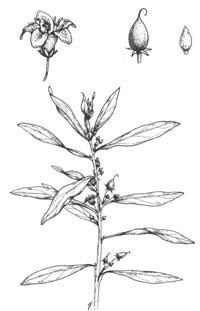
Myoporum is a small, bright green, evergreen
tree or shrub with a broadly spreading crown. The rather narrow, sub-fleshy
leaves are bright green and shiny with translucent dots. Young twigs and leaves
are bronze-green and sticky. Branches are stout and spreading, and trunks have
thick, furrowed bark. This plantÛªs rapid growth, branching and spreading habit,
and dense foliage make it useful as a thick, high screen or hedge. Growing
alone, it is a handsome multi-trunked plant.
åÊ
|
|
Description:
|
| Myoporaceae. Tree or shrub from 9 to 30 ft (3-10 m) high and 20 ft (6 m) wide with trunks 8.7-20 in (23-50 cm) in diameter. Stems: much branched, broadly spreading; twig tips and young leaves bronze-green, sticky. Leaves: 3-4 in (7-10 cm) long and 0.7- 1.3 in (2-3.5 cm) wide, alternate, generally lanceolate to oblong-lanceolate, acute to acuminate; margins crenulate-serrulate in upper half, sinuate in lower half or sinulate throughout (different forms found on same plant), bright green, +/-fleshy with conspicuous translucent pores, and petioles. Inflorescence: axillary cymes on peduncles up to 0.6 in (15 mm) long with 2-6 flowers. Flowers: bisexual, radial to bilateral; calyx 5-lobed. persistent; corolla 5-lobed, bell-shaped, about 0.4 in (1 cm) in diameter, white with purple spots; generally 4 stamens, epipetalous; ovary superior with 4 locules, 1 style, 2 stigmas. Fruit: seed in clusters of 2-6; each 0.5 in (1 cm), in ovoid drupe, fleshy, pale to dark reddish purple (Hickman 1993). |
|
åÊ
|
|
WHERE WOULD I FIND IT?
|
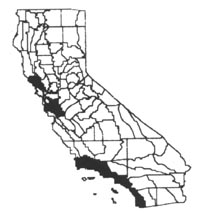
Myoporum flourishes in coastal areas in the
San Francisco Bay region and in Los Angeles, Marin, and Orange counties, and may
be found along the coast from Sonoma County to San Diego County. It has
naturalized in Hawaii.(Correction, April 2008: It is not known to be cultivated or naturalized in Hawaii.) It is most common in urban, disturbed areas, below 900
feet (300 m) elevation, where it forms dense monocultures if not controlled. It
grows well in heavy, alkaline, brackish, and sandy soils. Its invasive
tendencies have not been observed in interior regions.
åÊ
|
|
WHERE DID IT COME FROM AND HOW IS IT SPREAD?
|
This myoporum (Myoporum laetum) is native to
New Zealand; it is one of thirty-two species in the genus (Allen 1982). Myoporum
species are found widely in Australia and the South Pacific. M. laetum was
introduced to California as a horticultural species (Griffiths and McClintock,
1971). It spreads via prodigious seed production. The drupes are attractive to
birds, which disperse them over long distances. M. laetum is not known to spread
by vegetative means, but it can resprout from stumps.
åÊ
|
|
WHAT PROBLEMS DOES IT CAUSE?
|
Myoporum’s heavy seed production results in
dense monocultures that outcompete other species. If not controlled, it will
take over large areas. Extending outward, the area it shades enlarges each year.
Seed dispersal by birds results in rapid expansion of infested areas.
Slower-growing native species near myoporum become stunted or fail to grow until
myoporum is removed. Leaves and fruits are toxic and may be fatal to livestock.
The toxin (ngaione) is a furanoid sesquiterpene ketone that constitutes 70 to 80
percent of oil of ngaio, an essential oil (Fuller and McClintock 1986). The
fruit is less toxic than the leaves, and toxin is released with leaf fall
(Salmon 1986).
It has been reported that, because the interior of large plants
contains an accumulation of dead branches, myoporum burns with an intensity that
seems in contradiction to its lush, dark green foliage. This is of concern in
areas prone to wildfires.
À_
|
|
HOW DOES IT GROW AND REPRODUCE?
|
Little information is available on the
growth and reproduction of myoporum. It reproduces only by seed.
|
Plants bloom in early spring. In areas with water available, it grows rapidly into large, dense stands. It is surprisingly drought tolerant. Myoporum is sensitive to frost, and temperatures more than five degrees below freezing cause severe damage and dieback (Poole 1990).
|
(click on photos to view larger image)
|
|
|
HOW CAN I GET RID OF IT?
|
Annual monitoring is necessary when seed
sources are plentiful, and annual seedling removal is essential. Post-fire
monitoring is essential in areas prone to myoporum incursion.
åÊ
|
|
Physical control:
|
Mechanical removal: Seedlings can be pulled,
but they have long, strong taproots, and pulling must be done when the soil is
moist and the plant is small. If the root remains in the ground the plant will
resprout with vigor. Seedling removal with cut-stump treatment produces the best
results.
Prescribed burning: No information is available about the
efficacy of prescribed burning in infested areas. However, specimens have
resprouted after wildland fires, and post-fire seedling recruitment competes
with native plants for reestablishment.
åÊ
|
|
Biological control:
|
Insects and fungi: This has not been investigated for myoporum.
Grazing: Grazing is not
an option because of the toxicity of this species.
|
|
Chemical control:
|
Trunks should be cut at ground level and
saturated with concentrated glyphosate. Leaving any amount of stump may allow
resprouting. Cut surfaces must be monitored and retreated as needed. Contact a
certified herbicide applicator for additional information on any newly
registered herbicides that may be appropriate and approved for this
species.
åÊ
|