|
Aptenia cordifolia
|
|
|
|
Scientific name
|
Aptenia cordifolia
|
|
Additional name information:
|
(L.f.) N.E. Brown
|
|
Common name
|
apple, baby sun rose, heartleaf iceplant, dew plant
|
|
Synonymous scientific names
|
Mesembryanthemum cordifolium
|
|
Closely related California natives
|
0
|
|
Closely related California non-natives:
|
8
|
|
Listed
|
CalEPPC Red Alert,CDFA nl
|
|
By:
|
Jo Kitz
|
|
Distribution
|
|
HOW DO I RECOGNIZE IT?
Distinctive features:
|
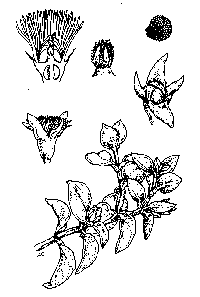
Red apple (Aptenia cordifolia) is a perennial herb,
spreading over ground and neighboring vegetation, with small, heart-shaped, dark
green succulent leaves interspersed with small, axillary, many-petaled, bright
pink to purple flowers that open only in sun. The hybrid red apple (with
Platythyra haekeliana) has brighter red flowers.
|
|
Description:
|
Aizoaceae. Stems: prostrate, 12-18 in (3-6 dm), nodes
widely spaced, base of stems woody. Leaf: 0.4-1.2 in (1-3 cm), petioled,
cordate, minutely papillate. Inflorescence: flower solitary, axillary;
peduncle 0.25-0.6 in (8-15 mm). Flower: hypanthium 0.2 in (6-7 mm);
sepals, four of unequal size +/-0.2 in (5mm), the largest flat, the others
awl-shaped; petals numerous 0.2 in (3 mm), ovary inferior. Fruit: 13-15 mm
four locular capsule (Hickman 1993).
|
|
|
|
WHERE WOULD I FIND IT?
|
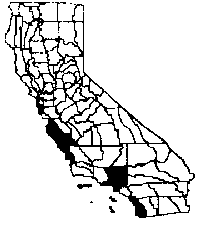
In California, red apple is found in disturbed places and on
margins of coastal wetlands, usually less than 100 feet (30 m) elevation.
Naturalized in California, it is reported in central and southern California and
on embankments along irrigation waterways in the Central Valley (Hickman 1993).
It has naturalized also in Oregon, St. Lucie County, Florida, and along the
southern coast of Europe. It is marketed as a fire-resistant (unproven),
drought-tolerant ground cover in California. It is planted in parking lot
planters, parkways, home gardens, in the urban interface near parks and
preserves, and on brush-cleared hillsides and stream embankments. It can
tolerate some soil salinity and grows well in dryish, frost-free or almost frost
free areas in full sun.
|
|
WHERE DID IT COME FROM AND HOW IS IT SPREAD?
|
Red apple is native to the eastern coastal region of the Cape
Province and Kruger National Park in the Transvaal, both in South Africa, and
was brought to California as a horticultural plant (Herre 1971). It is sold
widely in plant supply stores. It is known to spread vegetatively by rooting of
branches. Seed dispersal capabilty is not known.
|
|
WHAT PROBLEMS DOES IT CAUSE?
|
When watered, red apple overwhelms all neighboring
vegetation, climbing over anything in its path. It is listed as a wildland
weed red alert as it has only recently become a problem. It has been used
in landscaping adjacent to riparian areas within the urban interface, so
it can easily spread into and dominate more natural riparian and wetland
areas.
The author’s first introduction to this plant was at a
hilltop residence in San Luis Obispo County, where it had been planted
under oak trees and watered daily. It had grown five to six feet (2 m) up
the oak trees, cloaked three-foot (1 m) ceanothus shrubs, and formed a
thick mat by growing over itself. Distinctive features of the landscape
had surrendered to an unbroken cloak of red apple. As testimony to its
vigor against other invasive monocultures, it has been seen overgrowing
Vinca major.
|
|
HOW DOES IT GROW AND REPRODUCE?
|
Red apple grows rampant and leggy with water and/or shade and
compactly when not watered. Its morphological characteristics indicate that it
can over-summer without water and then grow vigorously during the rainy season,
although constantly wet soil can cause it to rot. It spreads vegetatively. Nodes
root when they touch the ground (Bailey 1949). It blooms in spring and summer.
Seeds grow well in sandy, well drained soil and germinate at 60-65 degrees F.
More information is needed on seed viability and potential for seed
dispersal.
|
|
(click on photos to view larger image)
|
|
HOW CAN I GET RID OF IT?
|
Little is known about control, but red
apple should respond to the same methods as the related sea fig (Carpobrotus
edulis) and New Zealand spinach (Tetragonia
tetragonoides).
|
|
Physical control:
|
Manual methods: Red apple can be easily
removed by hand pulling. However, because of the ability of this plant to grow
roots and shoots from any node, all live shoot segments must be removed from
contact with the soil to prevent resprouting. If complete removal is not
possible, mulching with the removed plant material is adequate to prevent most
resprouting, but requires at least one follow-up treatment to remove resprouts.
|
|
Chemical control:
|
The herbicide glyphosate (as Roundupå¨) has
been effectively used to kill related sea fig clones at label-recommended
concentrations of 2 percent or higher. The addition of 1 percent surfactant to
allow penetration of the cuticle on the leaves should improve effectiveness.
|