|
Leucanthemum vulgare
|
|
|
|
Scientific name
|
Leucanthemum vulgare
|
|
Additional name information:
|
Lam.
|
|
Common name
|
ox-eye daisy, marguerite, moon daisy, dog daisy
|
|
Synonymous scientific names
|
Chrysanthemum leucanthemum
|
|
Closely related California natives
|
15
|
|
Closely related California non-natives:
|
7
|
|
Listed
|
CalEPPC Red Alert,CDFA nl
|
|
By:
|
Maria Alvarez
|
|
Distribution
|
|
HOW DO I RECOGNIZE IT?
Distinctive features:
|
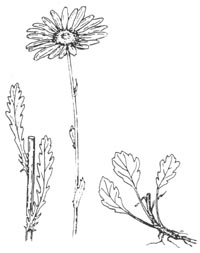
Ox-eye daisy (Leucanthemum
vulgare) is a prostrate herb with stems that sprout laterally from a
creeping rootstock. When in flower, the plantÛªs height ranges from one to three
feet. The white-petaled flower-like inflorescences have yellow centers. Leaves
are dark green on both sides, one to two inches long, smooth, and pinnately
lobed or toothed. The number of flower stalks ranges from one to forty per
plant.
åÊ
|
|
Description:
|
| Asteraceae. Perennial herb. Stems: simple or branched and prostrate. Flower stems 1-3 ft (30-90 cm) tall. Leaves: entire to pinnately lobed or toothed along stems. Lower basal and middle leaves longer, |
|
|
|
WHERE WOULD I FIND IT?
|
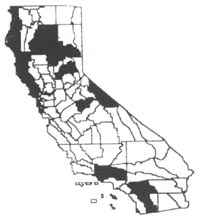
Ox-eye daisy is found in both the North
Coast Range and northern Sierra Nevada from sea level bluffs and canyons to
ÛÏalpineÛ mountain meadows to 7,000 feet (2200 m) and from central California
into Oregon. It is also common from the northeastern seaboard through the
Midwest. Ox-eye daisy is also a problem at Rocky Mountain National Park (USGS
1999). It is a common weed of disturbed areas such as roadsides, fields, and
pastures and former homesteads (Cowell 1973, Peck 1993). It readily spreads into
wildlands. Ox-eye daisy is found in a variety of plant communities including,
prairie, scrub, wet meadows, riparian forests, and open-canopy forests. It
thrives in a wide range of conditions and in full sun to semi-shade. Plants are
shallowly rooted to three inches (7.5 cm) deep and tolerate a wide range of soil
moisture conditions, but do particularly well in soils that are heavy and damp
(Parsons 1992).
åÊ
|
|
WHERE DID IT COME FROM AND HOW IS IT SPREAD?
|
Ox-eye daisy is native to Europe (Polunin
1969). It was probably introduced to North America as an ornamental early in the
twentieth century. It is currently used as an ornamental, and is it often sold
commercially in seed packets labeled as wildflower seed. Ox-eye daisy spreads
through abundant seed production and vegetatively by rooting underground stems
(rhizomes) (Griswold 1985). Seeds have no special adaptations to aid dispersal,
but are small and fall to the ground up to two meters from the parent plant.
When the flowerheads are dry, the seeds drop or are shattered easily by touch or
movement. Water, human and animal foot traffic, and cultivating and earth-moving
machinery can carry seeds into new areas.
åÊ
|
|
WHAT PROBLEMS DOES IT CAUSE?
|
Ox-eye daisy displaces native plant
species, growing so densely it excludes other vegetation. It is not known to be
used as forage by animals in California. While not considered poisonous to cows,
it does impart a disagreeable taste to their milk. Ox-eye daisy is a host for
several viral diseases affecting crops, including the yellow dwarf virus of
potatoes (Parsons 1992). It is difficult to control or eradicate because of its
large seedbank, long viability of seed, and ability to resprout if not
completely removed.
åÊ
|
|
HOW DOES IT GROW AND REPRODUCE?
|
Ox-eye daisy is capable of reproduction the first summer after it becomes established, regardless of plant size. Plants one inch in diameter have been observed bearing a single flower. Stem growth is prostrate and creeping until development of erect flowering stalks one to three feet (30-90 cm) tall. Flowering commences in late spring (May) and continues until late summer (August). Seed production is prolific when water is adequate. Most ox-eye daisy seeds remain viable for twenty years in the soil, and can remain viable after passing through digestive tracts of animals (Parsons 1992). Seeds germinate continuously as long as there is adequate moisture, fall through late spring in coastal regions. Plant growth slows during periods of flowering and low water availability.
|
Seed germination is inhibited by continuous darkness but otherwise not affected by variation in light (Thompson 1989). Studies have indicated that ox-eye daisy seedling germination and frequency are greater under increased moisture in hollows versus ridges, but dense groundcover can prevent ox-eye daisy establishment (Reader 1991).
|
(click on photos to view larger image)
|
Ox-eye daisy can grow year-round, and its
lifespan is indeterminate. Maximum growth has been observed in coastal regions
at onset of cool fall weather, through winter and spring, just before flowering
stalks shoot up. Aerial growth dies back after seed release. Vegetative growth
slows in summer during and after flowering (Cowell 1973).
åÊ
|
|
HOW CAN I GET RID OF IT?
|
Little information has been published on mechanical, cultural,
or biological control of ox-eye daisy. An important consideration is that seeds
remain viable in soil for at least two years.
The first step in the control
of ox-eye daisy is to develop a containment strategy. Removal methods will
depend on environmental variables and the type of plant community infested.
Primary methods of dispersal besides seed drop should be identified. If plants
are growing along trails, shoes and hooves picking up seeds in wet soil may
disperse them. People also pick the bright flowerheads, from which ripe seeds
may fall as they hike through the region. Information about the daisies should
be posted to alert wildland users. Small outlying populations should be treated
first.
Complete eradication of a large, well established, and
geographically widespread population of ox-eye daisies can be difficult because
of their small size and abundant seed production. Prolific seed set and the
ability of rhizomes to resprout make successful removal dependent on
appropriately timed treatment and persistent follow-up. Removal sites should be
inspected before plants have set a new crop of seed in June. If the infestation
is small it may be difficult to locate the previous yearÛªs removal site, so the
site should be mapped and marked with colored flagging or pin flags, especially
if follow-up will be done by someone else. If plants are mulched, the mulch will
serve as an effective indication of the location of the infestation. It is much
easier to locate daisies after flowering begins, which is typically by mid-June
in coastal California populations.
åÊ
|
|
Physical control:
|
Manual methods: A combination of hand removal and mulching is
used to control ox-eye daisy in the Golden Gate National Recreation Area
(GGNRA). If the infestation is small (less than 0.25 acre) or widely scattered,
hand removal may be efficient. Using a small hand pick, chip around the base of
the plant several inches deep to loosen the plant. Then lift the entire plant
out intact without leaving any stem pieces (rhizomes) behind. Check for rhizome
fragments, since an entire plant can regenerate from them. A round-point shovel
is effective for scooping out whole plants. If the soil is flat and compacted, a
sharp garden spade can also be used to scrape the plant out of the soil. A hula
hoe is also handy for scraping away abundant masses of seedlings or small
plants.
Mechanical methods: In Australia shallow cultivation of less
than six inches (15 cm) was found to have little effect and was likely to spread
roots. Cultivation greater than six inches in summer exposes roots to
desiccation. Subsequent shallower cultivations kill seedlings. This technique
opens the soil to infestation by other weeds and must be combined with dense
revegetation with desirable seed (Parsons 1992).
Mulching: The most successful non-chemical method found for
removing large infestations in GGNRA is to mulch heavily. Habitat Restoration
volunteers at the GGNRA have successfully eliminated masses of mature and
immature plants through the application of rice straw. One application 3-4 in
(7.5-10 cm) thick when compacted was successful in two plant communities in the
Marin Headlands: coastal scrub and wetland. Straw should be applied in fall at
the onset of the growing season. One bale will cover approximately 100 square
feet. The site should be monitored in early spring. If any live plants are found
under the straw, or any light can reach the soil, then another thick layer
should be applied before flowering begins in May. Native perennial plants at the
Marin Headlands site came up through the straw, while the ox-eye daisy did not.
This is because ox-eye daisy is a prostrate plant except for its flower stalks.
Ox-eye daisy was observed to rot under the dense mulch maintained throughout the
winter. If the infested area has a lot of woody plants they can make it
difficult to mulch thickly and lopping or brush cutting may need to be
undertaken first. Certified rice straw was used to avoid introduction of
terrestrial weed seeds. Other mulches have not been tried. Wood chips might also
be effective if they are applied thickly enough.
Winter monitoring is critical for mulched treatments in order to
assess the condition of the mulch before growth surges in spring. If ox-eye
daisies are seen growing through the mulch, it may have to be applied again.
Check to see if the plants are seedlings or adults. When mulch is adequately
applied the first time seedlings should not grow through it. Humans or animals
may have passed through the area and disturbed the mulch. Where mulch is
thinning, it should be re-applied, especially if there is a month or more of wet
weather to come, or if the site is a wet habitat. Once a mature population is
removed from the area, a crop of seedlings will take their place. Therefore, the
length of time the area should remain mulched depends on the size of the
seedbank and longevity of ox-eye daisy seeds in it. Along edges that are
difficult to mulch, spot removal can be done by hand.
Prescribed burning: This approach has not been assessed for
ox-eye daisy.
åÊ
|
|
Biological control:
|
Insects and fungi: Biological
control has not been investigated for this species.
Grazing: Intensive cattle grazing is an effective control for
ox-eye daisy. Although cattle tend to avoid it because of its high acidity,
under high stock density in an intensive grazing system, cattle eat this species
(Wallander et al. 1991).
åÊ
|
|
Chemical control:
|
Picloram, imazapyr, sulfometuron methyl, and dicamba are
effective at label concentration when applied in the early flowering stages, but
these herbicides persist in the soil (Parsons 1992). Ox-eye daisy is moderately
resistant to MCPA, 2,4-D, and dicamba (Stubbendieck et al. 1992), and these
herbicides may damage non-target species.
åÊ
|