|
Cytisus striatus
|
|
|
|
Scientific name
|
Cytisus striatus
|
|
Additional name information:
|
Rothm.
|
|
Common name
|
Portuguese broom
|
|
Synonymous scientific names
|
none
|
|
Closely related California natives
|
0
|
|
Closely related California non-natives:
|
7
|
|
Listed
|
CalEPPC List A-1,CDFA nl
|
|
By:
|
Maria Alvarez
|
|
Distribution
|
|
|
HOW DO I RECOGNIZE IT?
Distinctive features:
|
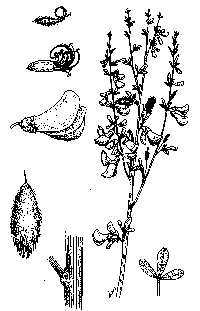
Portuguese broom (Cytisus striatus)
is a shrub six to nine feet tall with many slender eight- to ten-angled stems
that are silky-haired when young and become more or less smooth when mature.
Stems are covered sparsely by small leaves consisting of one to three leaflets.
Pale yellow, pea-like flowers arise from the leaf axils singly or in pairs.
Mature fruit pods are densely white-hairy, and each contains several seeds. The
main features that distinguish this species from Scotch broom (Cytisus
scoparius) are the paler yellow flower color, the greater number of angles
on the stem, the flat-hairy calyx (sepals), and the densely white-hairy fruit
pods of Portuguese broom. The pods of C. striatus are generally larger
than those of French broom (Genista monspessulana). The inflorescences
of French broom contain four to ten flowers per cluster with flower pedicels
less than one-half inch, whereas Portugese broom pedicels are greater than
one-third inch.
åÊ
|
|
Description:
|
Fabaceae. Long-lived shrub. Stems: young plants (1-3 years) have an upright form (erect) dominated by a leading apical stem. Plants become more branched and broaden with age, attaining a height of 7-10 ft (2-3 m). In windy locations growth is more compact and stunted, to 3-5 ft tall. Leaves: more abundant at outer ends of actively growing branches, giving the plant a broom- or antler-like appearance; leaflets 0.3-0.5 in (5-15 mm) long and obovate (pointed at both ends). Leaflet upper surface
generally smooth (glabrous); lower leaflet surface silky-hairy. Leaflets on
upper branches sessile, lower branches contain short petioled leaflets. |
|
Flowers:1-2 pea-like flowers cluster between leaf base and stem on pedicels 5-10 mm
long. Flower calyx is appressed hairy and
åÊ
|
|
WHERE WOULD I FIND IT?
|
Portuguese broom is much less common than
other broom species. It currently occupies sixty-five acres in the Marin
Headlands, Marin County, where it forms dense cover, one mature shrub per two
square meters. It is found occasionally in other parts of the Bay area, and has
been reported in Mendocino and San Diego counties, with probable occurrence in
central and south coastal counties. It is capable of invading and establishing
dense populations in coastal prairie, coastal scrub, oak savannah, and
open-canopy woodlands. In the San Francisco Bay Area it is particularly common
on non-calcareous soils.
åÊ
|
|
WHERE DID IT COME FROM AND HOW IS IT SPREAD?
|
Portuguese broom is native to Portugal
(Hickman 1993). Introduced to the Marin Headlands, Marin County, in the 1960s
for landscaping and slope stabilization, it escaped and naturalized. Portuguese
broom probably spreads like Scotch broom; that is, after ballistic dispersal,
seeds may be further dispersed by ants, animals, by rain wash on open ground, or
in mud clinging to road grading or maintenance machinery.
åÊ
|
|
WHAT PROBLEMS DOES IT CAUSE?
|
Portuguese broom displaces native plant
species, both herbs and other woody species. Its seeds are toxic to ungulates,
and mature shoots are unpalatable. Like Scotch broom, it is fire prone and
capable of carrying fire to the tree canopy layer.
åÊ
|
|
HOW DOES IT GROW AND REPRODUCE?
|
Portuguese broom becomes reproductive at two to three years of age at a height of one and a half to three and a third feet (40-100 cm). It flowers in late March through May on the coast, resulting in copious production of long-lived seeds that mature in June and July. Seeds are released ballistically from the pod, then further dispersed by animals and water runoff along the ground. Seed germination is probably similar to related broom species such as Scotch broom (Cytisus scoparius). Portuguese broom can resprout from its root crown when cut, particularly during the growing season.
|
Population growth is slower for Portuguese broom than for French broom, making containment a possibility. Drought conditions during summer cause growth to cease. Little dieback is observed during summer in the Marin population, probably because fog drip in late summer can be substantial. New growth resumes in winter and spring prior to flowering.
|
(click on photos to view larger image)
|
Some large individuals can be killed by an
unusually long freeze, perhaps limiting its geographic distribution (Alvarez
pers. observation). It takes two to three years to reach reproductive maturity,
but individuals can survive at least twelve years in California.
åÊ
|
|
HOW CAN I GET RID OF IT?
|
Portuguese broom is difficult to remove
because of the large size of individual plants, deep roots, and a long-lived
seedbank. Removal should be followed by five years of monitoring and follow-up
treatments to achieve control of this species. With limited resources, it is
particularly important to determine the primary direction in which the
population is expanding and start removal efforts there. Prevent seed dispersal
into uninvaded areas by removing widely dispersed individuals from the main
population center. Focus on preventing seed set and dispersal from all mature
individuals each season so that no net increase in the seedbank can
occur.
åÊ
|
|
Physical control:
|
A combination of hand pulling, brush cutting, and mulching is the most effective
way to remove mature plants and control reestablishment when chemicals, heavy equipment,
and fire cannot be used.
Manual methods: Small plants can be hand pulled when the soil is
moist. Larger plants can be pulled easily with a weed wrench if they are not too
branched near the base of the plant. If densely branched, long-handled loppers
or a pruning saw can be used to remove the lower limbs before pulling shrubs (1-
to 3-inch-diameter trunks) with an appropriately sized weed wrench.
To maximize effectiveness of manual control for large broom
plants, removal should be timed for late summer or early fall, when drought
conditions exist. Plants can be cut at ground level, leaving the stump exposed.
If warm conditions persist, it is likely that the plants will not resprout.
Stems and stumps should be cut close to the ground to minimize resprouting. For
additional insurance against resprouting from a stem, peel any bark back to the
ground, or split the stump into shreds with a hand axe or the axe end of a
pulaski. The GGNRAÛªs Habitat Restoration Program has achieved 60 to 80 percent
mortality by hand cutting alone during late summer and early fall in the Marin
Headlands.
Mechanical methods: Brush cutters with four-pointed blades and
chainsaws are also effective for removing Portuguese broom. However, it is
difficult to brush cut broom flush with the ground on steep, uneven terrain,
which may account for the resprouting of brush-cut broom in such areas.
Mowing has had mixed results on Portuguese broom. Marin State
Parks and U.C. Extension have utilized various forms of mowing, and this method
should be investigated furtheråÊ (Peterlee 1990, Nelson 1994). Mowing prior
to flowering can be effective in preventing another seed crop. The overall
length of the perimeter of the population should first be reduced by eliminating
peninsulas or finger-like extensions so that seed dispersal and establishment
are slowed. Then the infestation can be treated in a concentric fashion each
season, reducing the size of the main infestation over time.
Mulching: If there is a large seedbank, three to four inches
(7.5-10 cm) of straw (certified noxious weed free) should be applied. Mulching
should be done during winter or spring before seedlings are over an inch tall. A
controlled study by the Habitat Restoration Team demonstrated that mulching with
rice straw was 99 percent effective in preventing French broom seedlings from
emerging through straw for their entire germination period from December to
April. Mulching also increased the mortality of brush-cut French broom in the
same study when applied during winter (Alvarez unpubl. data).
Prescribed
burning: Treatment should follow recommendations for Scotch broom.
åÊ
|
|
Biological control:
|
Biological control agents have not been
reported for Portuguese broom.
åÊ
|
|
Chemical control:
|
Herbicides have not been used on Portuguese
broom in the Marin Headlands, and there are no published accounts of their use
elsewhere, but the treatments used on Scotch broom should be effective on
Portuguese broom.
åÊ
|