|
Cotoneaster spp.
|
|
|
|
Scientific name
|
Cotoneaster spp.
|
|
Common name
|
cotoneaster, silverleaf cotoneaster, rockspray cotoneaster
|
|
Synonymous scientific names
|
Cotoneaster buxifolius
|
|
Closely related California natives
|
Heteromeles arbutifolia
|
|
Closely related California non-natives:
|
0
|
|
Listed
|
CalEPPC List A-1,CDFA nl
|
|
By:
|
Jake Sigg
|
|
Distribution
|
|
HOW DO I RECOGNIZE IT?
Distinctive features:
|
Cotoneaster
pannosa and C. franchetii are
similar and frequently confused with each other, and some plants invading
wildlands are not readily assignable to a particular species. Both species are
evergreen shrubs, prostrate to erect, to ten feet tall, depending on species;
many-branched from ground level, the branches laden with clusters of
quarter-inch, white, rose-like flowers in summer followed by red berries in
autumn and winter. The branches usually zig-zag, producing a complex, interwoven
pattern.
åÊ
|
|
Description:
|
|
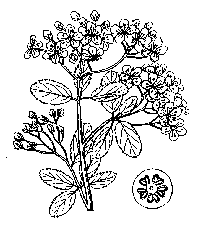
Rosaceae. Fountain-shaped to 3m (10
ft). Leaves: 3/4 in (2 cm) leaves are dull gray-green above, felty
beneath, and occur mostly in the upper part of plant. Flowers: those of
Cotoneaster pannosa are white, with fully opened petals; those of
C. franchetii
have erect petals that are strongly tinged pink.
Cotoneaster lacteus is profusely branched with
leaves from the ground up. Leaves are 3 in (8 cm), ovate, shiny dark green
above, densely hairy beneath, deeply pinnately veined. Fruits: orange-red
berries.
|
|
Cotoneaster microphyllus, rockspray cotoneaster.
Prostrate with dense, arching, mounding branchlets arising from flat
primary branch, which roots on contact with ground. Leaves: roundish and
shiny deep green, 0.25 in (0.5 cm) wide. Fruit: bright red
berries.
|
|
WHERE WOULD I FIND IT?
|
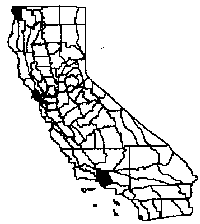
Cotoneasters have
escaped garden cultivation in widely scattered counties along the California
coast (Smith and Wheeler 1990). Some species have invaded coastal areas and
forests of the northwestern United States. They can be found in forests,
shrublands, and grasslands and can tolerate a wide range of environmental
conditions ranging from moist woodland and forest to open areas with thin, rocky
soils that are dry for long periods. Their absence in wildlands of the interior
indicates a need for coastal conditions, where frequent cool fogs reduce
transpiration. Cotoneaster pannosa and C. franchetii are both
naturalized in California. In Oregon and Washington only C. franchetii
has been reported, and then only in
waste places and roadsides.
åÊ
|
|
WHERE DID IT COME FROM AND HOW IS IT SPREAD?
|
Cotoneasters occur naturally in Eurasia, but the plants used in
gardens emanate almost exclusively from China, with a few from the Himalaya
(Hickman 1993). They were introduced into English gardens by the great plant
explorers of the nineteenth century. Rockspray cotoneaster arrived in England in
1824 and in California in 1854. Collectors sent additional kinds during the next
century, and by 1900 many species were available.
Considering that cotoneasters have been in California gardens
for so long, it is surprising that they have been reported as a problem in
wildlands only recently; the oldest shrubs in natural areas appear to be only
fifteen to twenty years old. This may be a result of subtle changes in the
environment that make ecosystems more vulnerable to invasion, to the build-up in
numbers of plants (cotoneasters are more commonly seen in gardens today, in part
because of natural seeding and in part because of their longevity), and to an
increase in the numbers of seed-dispersing birds. Changes in genotype of plants
may be another factor favoring invasiveness.
Although birds (cedar waxwings, robins, and their relatives)
consume large numbers of berries, most are not eaten and fall to the ground,
where many of them germinate. The numerous seedlings vigorously compete with
each other. Birds facilitate dispersal of seeds away from the parent
plant.
åÊ
|
|
WHAT PROBLEMS DOES IT CAUSE?
|
Cotoneasters displace native plants by
their rapid growth, competition for light, an aggressive, competitive root
system, abundant seed production, and an effective seed-dispersal strategy. They
may compete for the same ecological niche as the related native toyon
(Heteromeles arbutifolia) in part of the toyonÛªs range.
åÊ
|
|
HOW DOES IT GROW AND REPRODUCE?
|
Natural propagation is almost exclusively by seed. Plants grow through the spring months, flower in summer, and set fruit in autumn; berries persist through winter. Although cotoneasters are apomictic (able to produce seed without benefit of fertilization), their flowers are attractive to wasps (especially yellow jackets), and this apparently can result in sexual reproduction. The plants self-sow abundantly. Many seedlings are of intermediate character from parent plants and presumably are hybrids. These indeterminate plants occasionally are found in the wild.
|
The showy fruits are produced in abundance and are consumed by birds. Long-range seed dispersal by birds and the ability of cotoneasters to establish in seemingly healthy native ecosystems make them weeds to take seriously along the coast. Seed longevity is not known, but multi-year follow-up is always advisable for any weed. Cotoneaster seeds can germinate readily at any time of year in cultivation, but in California wildlands the only window of opportunity is with autumn and winter rains. Passage through a birdÛªs digestive tract may facilitate germination but is not necessary, as shown by prodigious germination of seed of uneaten berries beneath parent shrubs.
|
(click on photos to view larger image)
|
A secondary means of self-propagation is by
layering, that is, the rooting of branches that are in constant contact with the
ground. The root system is fairly deep and strong, as is common with shrubs of
the rose family. Layering is an important means of spreading in the case of
prostrate plants such as rockspray cotoneaster. After being cut down, or in
response to pruning, cotoneasters produce coppice shoots (Sunset
1996).
åÊ
|
|
Physical control:
|
Mechanical methods: Removal by a
weed-whacker may be feasible at the seedling stage, but it is imperative to cut
plants close to the ground, which risks hitting rocks. If herbicide is not
applied, the stump will produce profuse coppice shoots. Effort required to kill
the stump can be minimized by timing the initial cut to just after fruit set.
This maximizes depletion of stored energy in the root system, thus weakening the
plant. If plants are cut after fruit set but before fruit ripening, there is
less chance of mature berries falling to ground and creating new plants.
Frequent removal of coppice shoots will eventually starve the root, but if the
initial cut is not correctly timed, it could take two or three years to effect
kill. Stump removal is difficult and labor-intensive because of the tenacious
root system.
åÊ
|
|
Biological control:
|
Plant competition: The numerous seedlings
from a single parent plant vigorously compete with each other. Rather than spend
the time pulling out hundreds of small plants, it is better to wait a year or
two, when most are killed by sibling competition. The surviving few can then be
hand pulled in the moist season.
åÊ
|
|
Chemical control:
|
A cotoneaster can be killed by cutting down
its branches, which, because of their dense zig-zag pattern, is not easy. Cut
surfaces of the cambium-phloem layer should be painted with a 25 percent
solution of triclopyr (as Garlon 4å¨) herbicide with 75 percent cottonseed or
other light cooking oil as surfactant and inert ingredient. Glyphosate (as
Roundup Proå¨, 100% solution) may be substituted for triclopyr, but with less
certain results. Frilling the bark to expose more phloem adds to the absorptive
surface. Herbicide should be applied to cut surfaces immediately after cutting;
delay of even a few minutes may reduce or prevent effectiveness.
åÊ
|