|
Cortaderia selloana
|
|
|
|
Scientific name
|
Cortaderia selloana
|
|
Additional name information:
|
(Schultes) Asch. & Graebner
|
|
Common name
|
pampas grass, Uruguayan pampas grass
|
|
Synonymous scientific names
|
Arundo selloana, Cortaderia argentea, Gynerium argenteum
|
|
Closely related California natives
|
0
|
|
Closely related California non-natives:
|
Cortaderia jubata
|
|
Listed
|
CalEPPC List A-1,CDFA nl
|
|
By:
|
Joseph M. DiTomaso
|
|
Distribution
|
|
HOW DO I RECOGNIZE IT?
Distinctive features:
|
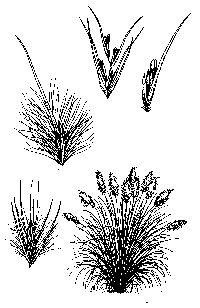
Pampas grass (Cortaderia selloana) is a
perennial grass six to thirteen feet tall with long leaves folded at the midrib
and arising from a tufted base or tussock. The inflorescence or flower cluster
is a plumed panicle at the end of a stiff stem. Stems are equal to or slightly
longer than the tussock. Plumes nearly always consist of light violet to
silver-white hairy female flowers that rarely produce seed. Pampas grass is
easily confused with jubata grass (C. jubata). The two species are distinguished
by several features, including stem height, leaf, plume, and spikelet color,
florets, leaf tip shape, and presence of viable seed. The tussocks of pampas
grass are more erect and fountain-like, not spreading, when compared to tussocks
of jubata grass.
| Characteristic |
Cortaderia selloana |
Cortaderia jubata |
| Stem (culm) height |
equal to or slightly longer than tussock in female
plants; two times longer in male plants |
2-2.5 times longer than tussock |
| Leaf color |
glaucous-green |
bright to deep green |
| Plume color |
ight violet to silvery white; female plants with
lighter plumes than males |
pinkish to deep violet |
| Spikelet color |
glumes white; males sometimes purplish near base
|
glumes purple |
| Florets |
males sparsely or not at all hairy; females densely
hairy at base, awns twice the length of hairs |
hairy at base; awn slightly extending beyond hairs
|
| Leaf tip |
bristly and curled |
not bristly or curled |
| Viable seed |
only when male and female plants are present
|
yes |
|
|
Description:
|
|
Poaceae. Perennial grass. Leaves: blades
to 6 ft (1.8 m) long, 1-3 in
(3-8 cm) wide, V-shaped in cross-section, bluish green (glaucous), upper surface
glabrous at base, lower surface glabrous or hairy towards collar, tips
bristly and curled, margins scabrous and sharp. Sheath: variable in hairiness, often glabrous, auricle-like outgrowth present at collar. Inflorescence: dense panicle, 1-4 ft (3-13 dm) long, stiff, light violet to silvery white when immature, white at maturity. Spikelets: numerous, 0.6 in (15-17 mm) long, typically with 6 florets in female plants and 3 in hermaphroditic plants. |
|
Florets: 0.16-0.3 in (4-8 mm) long,
glumes white or membranous, lemma long-hairy, awns 0.1-0.2 in (2.5-5 mm) long,
stigmas exerted (Hickman 1993, Robinson 1984). Caryopsis: viable seed rarely
found and, when present, not easily separated from rachilla.
åÊ
|
|
WHERE WOULD I FIND IT?
|
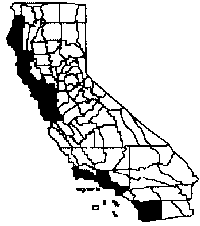
Pampas grass is common as an ornamental
throughout California, including interior regions. It has escaped cultivation
and spread along sandy, moist ditch banks throughout coastal regions of southern
California (Costas-Lippman 1977) below 1,000 feet (330 m). Its distribution is
not as extensive as Cortaderia jubata, but it appears to be expanding (DiTomaso
et al. 1998).
åÊ
|
|
WHERE DID IT COME FROM AND HOW IS IT SPREAD?
|
Pampas grass is native to Argentina,
Brazil, and Uruguay, where it grows in damp soils along river margins (Connor
and Charlesworth 1989). It was first introduced to Europe by a Scottish
horticulturist between 1775 and 1862. Samples were introduced to California
about 1848 by Joseph Sexton, a nurseryman from Santa Barbara. Commercial
production began in 1874 in both California and Europe. Until 1895 nurserymen in
the Goleta Valley near Santa Barbara were the primary producers of Cortaderia
selloana for ornamental use (Madison 1992). In 1946 it was planted by the Soil
Conservation Service throughout Ventura and Los Angeles counties to provide
supplementary dryland forage and prevent erosion (Costas-Lippman, 1977). Pampas
grass has escaped cultivation in many coastal areas in California, presumably by
fragmentation of the parent plant or, to a limited extent, by seed.
åÊ
|
|
WHAT PROBLEMS DOES IT CAUSE?
|
Although the more aggressive Cortaderia
jubata is often called pampas grass, true pampas grass (C. selloana) can also be
weedy in California. In other areas of the world, particularly New Zealand and
Australia, C. selloana is an important weed problem in forestry operations and
conservation areas (Gadgil et al. 1984, Harradine 1991). In forests it competes
with seedling trees and can slow their establishment and growth. Pampas grass
creates a fire hazard with excessive build-up of dry leaves, leaf bases, and
flowering stalks. In addition, heavy infestations can block access to
plantations and pose a significant fire hazard. In conservation areas pampas
grass competes with native vegetation, reduces the aesthetic and recreational
value of these areas, and also increases the fire potential.
åÊ
|
|
HOW DOES IT GROW AND REPRODUCE?
|
Pampas grass is
typically propagated for ornamental purposes through division of mature plants (Robacker and Corley, 1992). In nature it produces flowers two to three years after germination. Flowering usually occurs from late August though September (Madison 1992), but occasionally in winter. The species is considered gynodioecious, that is, flowers of some plants consist of both male and female parts on the same flower, but only the male parts are functional (Connor 1973). Other plants bear only female flowers. Thus, this species is functionally dioecious. Over the years, selection for ornamental plants in California has been for the showier plumes of the female plants. Consequently, few opportunities exist for seed production. This may account for the lack of spread of this species in California in past years.
|
In recent years some nurseries have
propagated pampas grass from seed. Since it is impossible to distinguish
male from female plants before they flower, the result is an increase in
the proportion of male plants in the population. Consequently, there has
been an increase in the amount of viable seed produced, and this species
has escaped to become an invasive weed along the California coast.
|
(click on photos to view larger image)
|
Populations that escaped from cultivation probably occurred in
areas where seeds were produced. This can occur when both male and female plants
are present in a population or when an occasional perfect flower (with both male
and female parts) is produced on a typically male plant. In New Zealand,
selection for female plants has not been as rigorous. As a result, more seed is
produced, and pampas grass has become a significant weed problem (McKinnon
1984). Little is known of the germination of Cortaderia selloana from
seed. Vegetative reproduction can occur when fragmented tillers receive adequate
moisture and develop adventitious roots at the base of the shoot.
Establishment of seedlings generally occurs in spring and
requires sandy soils, ample moisture, and light. Seedling survival is low in
shaded areas or in competition with grasses (Gadgil et al. 1990) or sedges.
Since few seeds are produced in California, little is known of the growth
requirements. Unlike Cortaderia jubata, C. selloana can tolerate winter
frost (Costas-Lippman 1977); it also tolerates warmer summer temperatures, more
intense sunlight, and moderate drought. This accounts for its success as an
ornamental in the Central Valley of California and its establishment as a weed
along the American River near Sacramento. Once established, roots of a single
plant can occupy a soil volume of about 1,100 square feet (103 m2). Lateral
roots can spread to thirteen feet (4 m) in diameter and eleven and one-half feet
(3.5 m) in depth (Harradine 1991). Plants are capable of surviving about fifteen
years (Moore 1994).
|
|
HOW CAN I GET RID OF IT?
|
Control of pampas grass is similar to that
of jubata grass. Few strategies are available for the control of Cortaderia
selloana. Burning does not provide long-term control, as plants resprout shortly
thereafter. Infestations sometimes can be averted by overseeding open disturbed
sites with desirable vegetation to prevent establishment of seedlings.
åÊ
|
|
Physical control:
|
Manual methods: Pulling or hand grubbing
Cortaderia selloana seedlings is highly effective. For larger plants however, a
pulaski, mattock, or shovel are the safest and most effective tools for removing
established clumps. To prevent resprouting, it is important to remove the entire
crown and top section of the roots. Detached plants left lying on the soil
surface may take root and reestablish under moist soil conditions (Harradine
1991). A large chainsaw or weedeater can expose the base of the plant, allow
better access for removal of the crown, and make disposal of the detached plant
more manageable (Moore 1994). Cutting and removing or burning the inflorescence
prior to seed maturation in late summer may be important if seed production
occurs in escaped populations of pampas grass. To reduce labor, the top of the
foliage can be removed and the remaining crown treated with diesel oil (Cowan
1976).
åÊ
|
|
Biological control:
|
Insects and fungi: No insect or fungal
control efforts have been investigated for any species of
Cortaderia.
Grazing: The success of grazing has not been reported in the
United States, but cattle have been shown to provide effective control for
pampas grass in commercial forests of New Zealand (Harradine 1991, Gadgil et al.
1984).
åÊ
|
|
Chemical control:
|
Control of pampas grass can be achieved by spot treatment with a
post-emergence application of glyphosate at about 2 percent solution or eight
qts/100 gal. The addition of a non-ionic or silicone-based surfactant may
enhance foliar penetration of the herbicide. For most effective control, plants
should be sprayed to wet, but not to the point of herbicide runoff. In one
study, over 90 percent control was obtained during the first season, but
continued spot applications were necessary to prevent rapid reestablishment
(Madison 1992).
Fall applications result in better control compared to summer
applications (Costello 1986) because photosynthetic assimilates are
translocating downward at a faster rate late in the season. However, if viable
seeds are produced, it may be necessary to apply the herbicide prior to seed
maturation. Although studies were conducted on jubata grass, it is likely that
low-volume (20 gal/ac) treatment with glyphosate at 4 percent can also provide
excellent control of pampas grass. The reduced volume can lower the amount of
herbicide used as well as the cost of the treatment (Drewitz et al. unpubl.
data). Rope wick applications of glyphosate have also proven effective, but good
coverage is essential or tillers will recover (Drewitz et al. unpubl.
data).
Other registered post-emergence herbicides useful for control of
Cortaderia jubata, may also be effective in the control of pampas grass.
For large clumps, the top foliage can be removed by cutting or
burning and the regrowth treated with a systemic post-emergence herbicide. This
method reduces the amount of herbicide applied compared to herbicide treatment
alone (Harradine 1991).
|