|
Conicosia pugioniformis
|
|
|
|
Scientific name
|
Conicosia pugioniformis
|
|
Additional name information:
|
(L.) N.E. Br
|
|
Common name
|
narrow-leafed iceplant, false iceplant, conicosia
|
|
Synonymous scientific names
|
Mesembryanthemum elongatum
|
|
Closely related California natives
|
0
|
|
Closely related California non-natives:
|
8
|
|
Listed
|
CalEPPC List A-2,CDFA nl
|
|
By:
|
Carla D’Antonio,Marc Albert
|
|
Distribution
|
Distribution:
|
|
HOW DO I RECOGNIZE IT?
Distinctive features:
|
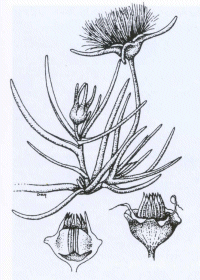
Conicosia (Conicosia pugioniformis) is a short-lived
succulent with prostrate to ascending shoots and a central, thickened taproot.
The taproot intergrades with a short, thick root crown, allowing for shoot
growth after inundation with sand. Leaves are slender, bright gray-green to
green, somewhat irregularly scattered along stems, and clustered near stem tips.
Flowers are large and solitary with numerous shiny, light yellow petals. The
fruit is a cone-shaped capsule that splits open when drying and is easily
dispersed by wind, spilling seeds as it tumbles. Conicosia is easily
distinguished from highway iceplant (Carpobrotus edulis) and sea fig
(C. chilensis) by its narrow, long, bright green leaves, lack of
rooting along trailing shoots, and absence of large clonal
mats.
|
|
Description:
|
| Aizoaceae. Perennial, usually short-lived. Roots: taproot, 1.6-3.3 ft (0.5-1 m) in length, swells extensively, especially in first year. Caudex: 0.8-8 in (2-20 cm) in length and up to 2 in (5 cm) in diameter, vertical growth apparently related to burial; intergrades with taproot. Stems: above-ground shoots decumbent, 1.66-5 ft (0.5-1.5 m) in length, moderately branched. Leaf arrangement: basal leaves form a loose rosette; cauline leaves alternate but somewhat irregularly arranged along stem. |
|
Leaves: narrowly linear to cylindrical,
rounded triangular in cross section, 6-8 in (15-20 cm) in length and 0.4-0.6 in
(1-1.5 cm) in diameter. Inflorescence: 1-flowered axillary peduncle,
åÊ
|
|
WHERE WOULD I FIND IT?
|
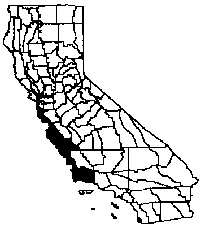
Conicosia is found in coastal dunes and
adjacent disturbed areas from the San Francisco peninsula to Point Conception,
California. It is locally abundant, with particularly large populations
occurring at Vandenberg Air Force Base and in the Guadalupe-Nipomo dunes. It is
most abundant in open patches on dunes and in recently disturbed areas (e.g.,
along trails, roads, and railroad rights-of-way) with sandy soil. It seems to
require well drained, sandy soils. It colonizes foredune, dune scrub, and, to a
lesser extent, coastal scrub, coastal prairie, and maritime chaparral
communities.
åÊ
|
|
WHERE DID IT COME FROM AND HOW IS IT SPREAD?
|
Conicosia is native to South Africa,
probably introduced to the United States as an ornamental in the early 1900s.
This species has only recently been noted as an important component of coastal
California habitats (Shmalzer and Hinkle 1987). Spread occurs by seeds.
Wind-dispersed capsules spill seeds from individual valves as they roll across
the ground. Capsules have been observed several meters from adult plants. This
low-growing, short-lived perennial has shoots that spread outward from a central
stem that remains at soil level. It can cover or intersperse with other
vegetation, and can be locally abundant. Spread does not occur by vegetative
propagules. Any soil disturbance (e.g., by hikers, bicycles, or off-road
vehicles) in established dune or coastal scrub areas could contribute to its
spread, as would intentional planting in areas near the coast.
åÊ
|
|
WHAT PROBLEMS DOES IT CAUSE?
|
Conicosia invades disturbance corridors
within coastal scrub or maritime chaparral and has the potential to inhibit
regeneration of native species in restoration sites. It colonizes recently
disturbed sandy areas, forming high-density populations that can preclude
establishment of other vegetation. In addition, it readily invades openings in
foredune and dune scrub communities, often becoming established under shrubs and
alongside subshrubs, graminoids, and herbs. It is likely that this results in
interference with the growth and establishment of native plants. Individual
conicosia plants produce many seeds in fruit capsules that are easily dispersed;
thus, once established in an area, it is difficult to stop further colonization.
Conicosia also may invade maritime chaparral following fire (Odion et al. 1992).
Other invasive members of this family have been shown to alter soil chemistry
(Vivrette and Muller 1972, DÛªAntonio 1990a). It is not currently known if this
plant can influence soil chemistry.
åÊ
|
|
HOW DOES IT GROW AND REPRODUCE?
|
Flowering occurs in late summer through autumn. Plants may flower in the first year, but flowering often begins in the second year. Plants can live ten years or longer (Bleck, pers. comm.). Reproduction occurs by seed. Plants flower in summer or fall of their first or second year and every subsequent year. As capsules dry, tissue from the upper surface of individual valves pulls away, allowing seeds to drop. Capsules separate from the plant when dry. Whole dried capsules are readily moved by wind. Individual capsules produce tens to hundreds of seeds. Plants can resprout from the buried root crown after above-ground tissue is removed.
|
Conicosia plants
can grow to several feet in diameter in a single growing season. Seeds
from dense populations can spread rapidly into adjacent areas. There are
currently no known studies of the physiological ecology of this species.
Seedlings appear to devote much of their photosynthate to the thickened
taproot; young individuals may have a taproot of one to three centimeters
in diameter but only a few small leaves.
|
(click on photos to view larger image)
|
Evergreen shoots may grow year round, with
most vigorous growth occurring December to June. Like other succulents and other
members of this family, conicosia may be able to alternate between CAM and C3
photosynthesis, which would allow for growth during periods of high temperature
and low water availability, or in places with high salinity.
|
|
HOW CAN I GET RID OF IT?
|
Removal of live plants is easily
accomplished by either mechanical or chemical means. Eradication of the species
from any large area, however, is complicated by the wind dispersal of seeds and
the propensity of conicosia to colonize disturbed areas. A critical component of
any control effort will be follow-up removal of seedlings.
åÊ
|
|
Physical control:
|
Manual methods: Plants are killed either by
hand pulling or by slicing the taproot with a shovel, pulaski, pick and hoe
tool, saw, or knife. Hand pulling is easy when plants are small (
Prescribed burning: Because of the high water content of shoot
tissues, burning live plants is not an effective method of control.
åÊ
|
|
Biological control:
|
Insects and fungi: There are no known
studies of biological control, and iceplant scale (Pulvinariella
mesembryanthemi, P. delottoi) has not been observed on this plant. Plants at
Vandenberg Air Force Base have appeared to be killed by dodder (Cuscuta
sp.).
Grazing: Because of the astringent and often salty quality of
the succulent tissue, grazing is not likely to be a control option.
åÊ
|
|
Chemical control:
|
Glyphosate applied with a surfactant by foliar spray in concentrations as low as 0.5 percent has been effective in killing seedlings and mature plants (Mulroy, pers. comm.).
|