Source: California Invasive Plant Council


URL of this page: http://www.cal-ipc.org/ip/management/ipcw/pages/detailreport.cfm@usernumber=27&surveynumber=182.php

Invasive Plants of California's Wildland

Centaurea melitensis
Scientific name   Centaurea melitensis
Additional name information: L.
Common name tocolote, Maltese star thistle, Napa star thistle, Malta starthistle
Synonymous scientific names none known
Closely related California natives 0
Closely related California non-natives: 11
Listed CalEPPC List B,CDFA nl
By: John D. Gerlach Jr.,Joseph M. DiTomaso
Distribution
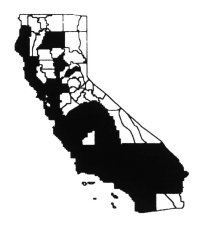
centaurea-mel-map

HOW DO I RECOGNIZE IT?
Distinctive features:

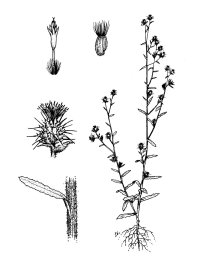
In California, tocolote (Centaurea melitensis) grows as a winter annual, producing one to several solitary or clustered, spiny, yellow-flowered heads during spring and early summer. The pre-bolting vegetative characteristics of this species are similar to those of yellow starthistle. Bolting occurs during early spring. The stem leaves extend downward, giving the stems a winged appearance. Flowerheads are generally produced from April through June (approximately four to six weeks before yellow starthistle begins flowering). Flowering plants range from two to thirty-six inches in height and may change from green to bluish green as they senesce. The main phyllaries are pinnately spined with an apical, needle-like spine and a few, much smaller, lateral spinelets. The apical spine bears a characteristic pair of spinelets approximately one-eighth inch  from its base. The heads produce only one type of fruit or achene, which is usually light brown with faint tan stripes and always bears a white pappus.

Description:
Asteraceae. Stems: at flowering stems range from 2-36 in (5-100 cm) in height. Leaves: basal are entire to lobed, green, resin dotted, often with scabrous hairs, 0.8-6 in (2-15 cm) long; cauline are long, entire, narrow, extending downward on stem; leaf blades 0.4-1.2 in (1-3 cm) long; initially green but sometimes becoming bluish green and lightly covered with cobwebby hairs later in the season. Inflorescences: produced April-June; heads 1 to several, solitary or in groups of 2-3; involucre 0.4-0.6 in (10-15 mm) tall, ovoid, often cobwebby; outer phyllaries with apical appendage pinnately spiny with a few pairs of spinelets; spine 0.2-0.4 in (5-10 mm) long, slender, with a characteristic pair of tiny spinelets about 1/8 in (2-4 mm) from the base. Flowers: many; corollas 0.4-0.5 in (10-12 mm) long, usually equal, yellow; outer ring of flowers sterile, ascending to erect; remaining interior flowers fertile, erect. Fruits: achenes 1/8 in (2-3 mm) long; typically light brown with tan stripes; all with white pappus, bristles usually 1/8 in (2-3 mm) long, but can be as short as 0.04 in (1 mm) (Gerlach unpubl. data), pappus bristles covered with rows of minute barbs; achene attachment scar acute, achene base narrow and hook-like (Hickman 1993, Roché and Roché 1988, Gerlach unpubl. data).
centaurea-mel-illus

WHERE WOULD I FIND IT?

Tocolote is widely distributed in California, but the largest populations are found in central-western and southwestern regions of the state (Hickman 1993). Scattered small to medium-sized populations occur in the San Francisco Bay Area, North Coast Ranges, and Sierra Nevada foothills.

WHERE DID IT COME FROM AND HOW IS IT SPREAD?

Tocolote was brought to California during the Spanish mission period. The earliest record of its occurrence was seed found in adobe bricks of a building constructed in 1797 in San Fernando (Hendry 1931). It appears to have been a contaminant in wheat, barley, and oat seed and was widely distributed in dry-farmed grain fields. In one instance its seed was found embedded in an oat floret (Stanton and Boerner 1936). Seed is transported by humans, animals, or wind, similar to starthistle (Gerlach unpubl. data).

WHAT PROBLEMS DOES IT CAUSE?

Dense infestations of tocolote displace native plants and animals, threatening natural ecosystems and nature reserves. It significantly reduces seed production of the endangered plant, Acanthomintha ilicifolia (Bauder unpubl. data). Long-term ingestion by horses causes a chewing disease, a lethal lesion of the nigropallidal region of the brain (Kingsbury 1964).

HOW DOES IT GROW AND REPRODUCE?
Tocolote generally flowers from April through June. Inflorescences can produce 1 to 100 heads with 1 to 60 seeds per head (Gerlach unpubl. data). Nothing is known about its pollination biology. Wild oat (Avena fatua) litter has been implicated as producing allelopathic compounds that significantly reduce seed germination (Tinnin and Muller 1972). A study of European plants found that young seedlings are resistant to the effects of fall drought (Espigares and Peco 1995). Little is known about the biology of tocolote. Seeds germinate after fall rains, bolting occurs in early spring, and plants flower from spring to early summer.
centaurea-mel-small2

(click on photos to view larger image)

centaurea-s&m-large2

Centaurea solstitialis on left; C. melitensis on right

HOW CAN I GET RID OF IT?

Little work has focused on the control of tocolote. However, it is likely that the strategies used to successfully control yellow starthistle (Centaurea solstitalis) will also provide effective control of this species. A possible difference in control would be methods for biological control.

Biological control:

Insects and fungi: No specific biological control agents have been released to control tocolote, and none of the agents introduced to control yellow starthistle have reproduced on tocolote. In a field test of alternate plant hosts, the weevil Bangasternus orientalis, which was introduced to control starthistle, did not reproduce on tocolote (Woods et al. 1995). While no biological control agents have been released to control this species, a small beetle inadvertently introduced into California has been found to destroy mature seeds in the seedhead (Pitcairn and Gerlach unpubl. data). This beetle, Lasioderma haemorrhoidale, was first collected in Santa Clara and Fresno counties during 1981, 1982, and 1983 (White 1990). In 1997 the beetle was found on Centaurea melitensis seed heads collected in San Diego and Colusa counties. The home range of the beetle is the entire Mediterranean region, and it appears to specialize on species in the thistle tribe (White 1990).