|
Carpobrotus edulis
|
|
|
|
Scientific name
|
Carpobrotus edulis
|
|
Additional name information:
|
(L.) N. E. Br.
|
|
Common name
|
highway iceplant, Hottentot fig, iceplant
|
|
Synonymous scientific names
|
Mesembryanthemum edule L
|
|
Closely related California natives
|
0
|
|
Closely related California non-natives:
|
8
|
|
Listed
|
CalEPPC List A-1,CDFA nl
|
|
By:
|
Marc Albert
|
|
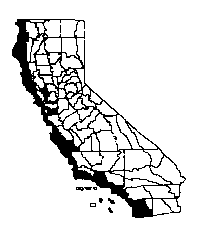
Distribution
|
|
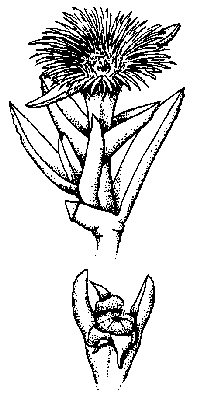
HOW DO I RECOGNIZE IT?
Distinctive features:
|
Highway
iceplant (Carpobrotus edulis) is a ground-hugging succulent perennial
that roots at the nodes, has a creeping habit, and often forms deep mats
covering large areas. Shallow, fibrous roots are produced at every node that is
in contact with the soil. Highway iceplant has been widely planted for soil
stabilization and landscaping, and is well known by most Californians for its
succulent three-sided leaves and its propensity to form deep mats and
monospecific stands. In California
flowering occurs throughout the year, peaking in late spring and early summer;
flowers do not appear to require specific pollinators.
åÊ
Highway
iceplant is easily confused with its close relative, the more diminutive and
less aggressive Carpobrotus chilensis (sea fig), and the two species
hybridize readily throughout their ranges in California.
The large, two and a half- to six-inch-diameter, soli-tary flowers of highway
iceplant are yellow or light pink, whereas the smaller, one and a half- to two
and a half-inch-diameter sea fig flowers are deep magenta. Hybrid flowers are
pink and intermediate in size. C. edulis hybrids also appear to be
invasive pest plants in wildlands (Albert et al. in
press).
åÊ
|
|
Description:
|
Native to coastal areas
of South Africa, a region with a Mediterranean climate similar to that of
coastal California, highway iceplant was brought to California in the
early 1900s for stabilizing soil along railroad tracks. It was later used
by Caltrans for similar purposes, and until the 1970s thousands of acres
were planted with iceplant. For several decades it was also widely
promoted as an ornamental plant for home gardens, and it is still
available at some nurseries. It will spread easily to natural areas via a
number of mammals (DÛªAntonio 1990a). Highway iceplant spreads both
vegetatively and by seeds. Individual clones can grow to at least 165 feet
(50 m) in diameter, and shoot segments can continue to grow if they are
isolated from the parent plant. This form of reproduction is important for
survival in beach and dune areas in which burial by sand occurs regularly.
The abundant seeds are dispersed by generalist mammalian frugivores. Seeds
have been found in deer scat more than a kilometer from the nearest clone
(DÛªAntonio 1990a). |
|
|
|
WHERE WOULD I FIND IT?
|
Highway
iceplant is found in coastal habitats from north of Eureka,
California,
south at least as far as Rosarita in Baja
California.
It has been planted (along with Carpobrotus hybrids) and is still
abundant along highways, on military bases, and in other public and private
landscapes. It spreads beyond landscape plantings and has invaded foredune, dune
scrub, coastal bluff scrub, coastal prairie, and most recently maritime
chaparral communities. Establishing readily after disturbance, its seedlings are
often seen along roads and on trails and gopher mounds, as well as in areas of
open sand and recently burned areas. It is intolerant of frost, and is not found
far inland or at elevations greater than approximately 500 feet (150
m).
åÊ
|
|
WHERE DID IT COME FROM AND HOW IS IT SPREAD?
|
Its ability to establish and grow in native plant communities differs
from one community to another (DÛªAntonio 1993). In coastal prairie it requires
rodent disturbance to provide suitable open soil and is usually outcompeted by
grasses at the seedling stage. Once established, however, highway iceplant can
spread rapidly by vegetative means. In foredune and dune scrub areas,
establishment is limited by herbivory (probably mostly by rabbits) but not by
competition, although growth is slow in the dry, low-nutrient conditions. In the
less harsh conditions of backdune scrub areas, seedling mortality is high as a
result of herbivory, but a moderate rate of growth allows for fairly rapid
vegetative spread.
åÊ
|
|
WHAT PROBLEMS DOES IT CAUSE?
|
Highway iceplant tolerates a range of soil moisture and nutrient
conditions and can establish and grow in the presence of competitors and
herbivores. These qualities and others have meant that in many natural areas it
has formed nearly impenetrable mats that dominate resources, including space. It
has invaded foredune, dune scrub, coastal bluff scrub, coastal prairie, and
maritime chaparral communities, and competes directly with several threatened or
endangered plant species for nutrients, water, light, and space (State Resources
Agency 1990). It can suppress the growth of both native seedlings (DÛªAntonio
1993) and mature native shrubs (DÛªAntonio and Mahall 1991). In addition, it can
lower soil pH in loamy sand (DÛªAntonio 1990a) and change the root system
morphology of at least two native shrub species (DÛªAntonio and Mahall
1991).
åÊ
An
indirect effect of highway iceplant on the communities it invades can be the
build-up of organic matter in normally sandy beach and dune soils, especially in
areas where dieback and regrowth have occurred or in areas where iceplant
has been treated with herbicide. This can result in invasion by non-native
plants that normally would not be able to establish in sandy soils. Another
indirect effect is the stabilization of dune sands, resulting in a change in the
natural processes that sustain dune community formation over time.
åÊ
|
|
HOW DOES IT GROW AND REPRODUCE?
|
Highway iceplant can reproduce both vegetatively and by seed. Flowering occurs almost year round, beginning in February in southern California and continuing through fall in northern California, with flowers present for at least a few months in any given population. Seed production is high, with hundreds of seeds produced in each fruit. Fruits mature on the plant and are eaten by mammals such as deer, rabbits, and rodents. Germination is enhanced by passing through animal digestive systems. Seeds in scat were found to have a higher germination rate than seeds from fruits that were not eaten (DÛªAntonio 1990a, Vila and DÛªAntonio 1998). Because of the ability to produce roots and shoots at every node, any shoot segment can become a propagule. This allows for survival of individual branch segments when they are isolated from the rest of the plant by being severed or buried by sand. For this reason it is important to remove all material from the site when attempting to eradicate this species.
|
Active growth appears to occur year round, with individual shoot segments growing more than three feet (1 m) per year (DÛªAntonio 1990b). All segments can produce roots at the nodes when in contact with soil, allowing for the formation of broad, thick mats. The impact on native competitors changes with the availability of water throughout the year, with the greatest impact occurring in times of drought (DÛªAntonio and Mahall 1991).
|
(click on photos to view larger image) |
|
|
|
|
HOW CAN I GET RID OF IT?
|
|
|
Physical control:
|
Manual methods: Highway
iceplant is easily removed by hand pulling, making it a good target for
community or school group restoration projects. Because the plant can grow roots
and shoots from any node, all live shoot segments must be removed from contact
with the soil to prevent resprouting. If removal is not possible, mulching with
the removed plant material is adequate to prevent most resprouting, but requires
at least one follow-up visit to remove resprouts.
Mechanical methods: Mechanical removal by bobcat or tractor is efficient
for areas in which there are no sensitive resources, although in order to
prevent significant soil removal, the use of a brush rake attached to the scoop
is recommended (Pickart, pers. comm.). Mechanical removal is effective at any
time of year.
åÊ
Prescribed
burning: Because of the high water content of shoot tissues, burning of live or
dead plants is not a useful method of control or disposal. Attempts to control
C. edulis by solarization or freezing also have been found to be
ineffective (Theiss and Associates 1994).
åÊ
|
|
Biological control:
|
Insects and fungi: There are currently no biological controls for
Carpobrotus edulis. The iceplant scale insects, Pulvinariella
mesembryanthemi and P. delottoi, have a small impact on some
individuals (Washburn and Frankie 1985), but would likely not be useful as a
control tool. In addition, occasional parasitism by dodder (Cuscuta sp.) can be seen, but its impact appears to be
minimal.
åÊ
Grazing: Because of the salty and astringent
quality of the leaves and the fibrous to woody quality of stems, grazing is
unlikely to be an effective control for highway iceplant.
åÊ
|
|
Chemical control:
|
The herbicide glyphosate has been effectively used to kill Carpobrotus
edulis clones at concentrations of 2 percent or higher. The addition of 1
percent surfactant to break apart the cuticle on the leaves increases mortality
(Moss, pers. comm.). Mortality reportedly is greater when the water utilized is
more acidic. Adding an acidifier to hard water before mixing with glyphosate can
increase the effectiveness of the treatment (Gray, pers. comm.). It takes
several weeks for the clones to die off, and resprouting can occur from
apparently dead individuals for several months afterward. Spraying should be
avoided in areas in which native species are interspersed with highway iceplant
clones. Impacts to native species can be reduced by treating iceplant in early
or mid-winter when most native plants are dormant (Moss, pers. comm. 1998).
Subsequent growth from seedlings needs to be controlled.
|