|
Mesembryanthemum crystallinum
|
|
|
|
Scientific name
|
Mesembryanthemum crystallinum
|
|
Additional name information:
|
L.
|
|
Common name
|
crystalline iceplant, common iceplant
|
|
Synonymous scientific names
|
Cryophytum crystallinum
|
|
Closely related California natives
|
0
|
|
Closely related California non-natives:
|
8
|
|
Listed
|
CalEPPC List B,CDFA noxious
|
|
By:
|
John M. Randall
|
|
Distribution
|
|
|
HOW DO I RECOGNIZE IT?
Distinctive features:
|
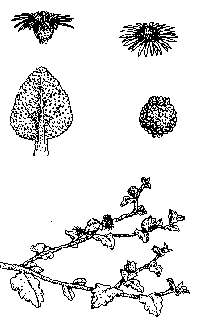
Crystalline iceplant (Mesembryanthemum
crystallinum) is a succulent, low-growing herb spreading over ground with
flat, fleshy leaves. Leaves and stems are covered with distinctive tiny, clear,
blister-like out growths. Flowers are small (one-fifth of an inch across) and
radial, with many narrow petals that range from white to pinkish, depend ing on
the age of the flower. The stems can range from green to red and usually trail
along the soil surface.
|
|
Description:
|
Aizoaceae. Prostrate annual (biennial)
herb. Stems: trailing, forked, and |
|
|
|
WHERE WOULD I FIND IT?
|
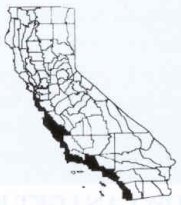
Crystalline iceplant occurs along the
immediate coast from the San Francisco Bay region south into Baja California,
Mexico. It can also be found on all the California Channel Islands (Junak et al.
1995, Munz 1974). A few plants have been observed up to eight miles (13 km)
inland (Vivrette and Muller 1977). It is found primarily in saline soils on
coastal strand, coastal sage scrub, coastal bluffs and cliffs, and other
disturbed ground. It tolerates saline soils, but not frost.
|
|
WHERE DID IT COME FROM AND HOW IS IT SPREAD?
|
Crystalline iceplant is native to South Africa and is thought to
have been in troduced to California, perhaps as early as the 1500s, in sand used
as ships’ ballast. About fifty years ago, the California Department of
Transportation began using iceplant for roadside landscaping and ero sion
control. This practice was discontinued in 1969 when it was discovered that the
plant was killed by hard freezes and not effec tive for erosion control on
steeper slopes. Many homeowners still use iceplant as a groundcover or for
erosion control (Moss 1994). The constant erosion of coastal bluffs creates an
open habitat that encourages colonization and spread of iceplant, as does
grazing disturbance in coastal grass lands.
|
|
WHAT PROBLEMS DOES IT CAUSE?
|
Crystalline iceplant can invade coastal bluff areas and compete
with native species. Because iceplant has an exceptional ability to absorb
moisture from the soil, it can outcompete most other species for water. A high
level of nitrate build-up has been found to occur underneath crystalline
iceplants, and this can be detrimental to survival of grassland seedlings
growing there. Accumulation and release of these salts by crystalline iceplant
also prevents or retards reestablish ment of native species (Vivrette and Muller
1977).
|
|
HOW DOES IT GROW AND REPRODUCE?
|
Crystalline iceplant usually flowers from March to June,
although, because germination is staggered, individual plants can be found
flowering most of the year. Fruiting generally occurs from June to August, after
which the plant gradually dries from the base upward, fruits being the last to
dry (Vivrette and Muller 1977). Rabbits and mice aid in dispersal of
seeds.
|
Seeds germinate with the first rains in autumn and with each
succeeding rain or heavy fog. Seedlings continue rapid vegetative growth until
spring. Vegetative stages are characterized by broad, flat leaves. Vegetative
growth slows and then stops as the hot, dry summer season progresses.
|
(click on photos to view larger image)
|
|
|
|
|
HOW CAN I GET RID OF IT?
|
Information specific to the control of crystalline iceplant is not available. Control techniques for Carpobrotus edulis, another invasive species in the same family (Aizoaceae) with similar growth form, would likely be effective.
|