Source: California Invasive Plant Council
URL of this page: http://www.cal-ipc.org/ip/management/ipcw/pages/detailreport.cfm@usernumber=12&surveynumber=182.php
Invasive Plants of California's Wildland
| Brassica tournefortii | |||||
| Scientific name | Brassica tournefortii | ||||
| Additional name information: | Gouan | ||||
| Common name | Sahara mustard, Asian mustard | ||||
| Synonymous scientific names | none known | ||||
| Closely related California natives | 0 | ||||
| Closely related California non-natives: | 8 | ||||
| Listed | CalEPPC List A-2,CDFA nl | ||||
| By: | Andrew Sanders,Richard Minnich | ||||
| Distribution |
| ||||
|
HOW DO I RECOGNIZE IT? Distinctive features: |
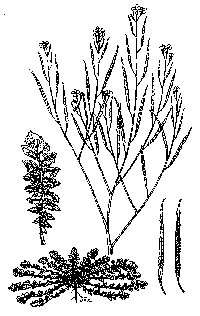
Sahara mustard (Brassica tournefortii) is an annual herb with stems four to forty inches tall. Plants flower early, but the flowers are small and dull yellow, making them inconspicuous compared to most other true mustards. Petals are less than one-quarter inch. Individual flower stalks are longer than the sepals and spread away from the stem. Fruits have an obvious beak at the tip. The pedicels of the fruits are one-half to four-183 fifths of an inch long and diverge stiffly from the stem at a forty-five degree angle. | ||||
| Description: |
| ||||
| WHERE WOULD I FIND IT? |
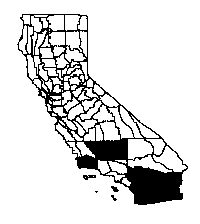
Sahara mustard is an abundant annual weed at low elevations throughout southwestern deserts of North America, including southern California, southern Nevada, Arizona, New Mexico, west Texas, and northwestern Mexico. In California it occurs in both the Mojave and Sonoran deserts, but is more common in the latter. It is becoming increasingly frequent in semi-arid south coastal California. It is found as high as 3,300 feet (1,000 m) elevation, but is especially abundant below 1,000 feet (305 m). Apparently uncommon at mid-century, this plant attracted little attention in southern California until recent decades when it began to be collected widely, mostly by botanists and students. In the late 1950s it was known only from Riverside, Imperial, and southwestern San Bernardino counties (Munz 1959). It was not reported in the Sonoran Desert flora until the mid-1960s (Shreve and Wiggins 1964). It seemed to have experienced a population explosion from 1977 to 1983, during successive years of above-normal precipitation, becoming well established in all counties of southern California. It was described as being a "rare adventive, usually in desert waste areas" as late as the mid-1980s in San Diego County (Beauchamp 1986). Now abundant in the Coachella, Borrego, and Imperial valleys of southeastern California, it is especially common in areas with wind-blown sediments. It is also invading exotic annual grassland and coastal sage scrub on the coastal slope of southern California. Plants were observed in Colton Dunes in southwestern San Bernardino County in the 1950s. First noticed in the Riverside area in 1988, it has spread throughout the city, including Box Spring Mountain and Mt. Rubidoux. It is abundant in Baja California, on both coasts. It often forms almost pure stands on abandoned sandy fields. Anderson (pers. comm.) observed a dense stand of the species near San Felipe on the northeast coast in about 1990. It had reached the extreme southern edge of Sonora by 1993 as an uncommon weed along roadsides. As far north as Coso, near the southern Owens Valley of the Mojave Desert, it is an uncommon weed of roadsides. Sahara mustard is most common in wind-blown sand deposits and in disturbed sites such as roadsides and abandoned fields. It is scarce on alluvial fans and rocky hillslopes. | ||||
| WHERE DID IT COME FROM AND HOW IS IT SPREAD? |
Sahara mustard is native to semi-arid and arid deserts of North Africa and the Middle East, as well as Mediterranean lands of southern Europe (Townsend and Guest 1980, Tutin et al. 1964, Zohary 1966) in habitats similar to those it now occupies in North America. The plant apparently was first collected in North America at Coachella in Riverside County by J.B. Feudge (#1660, RSA) on 25 February 1927. This collection was incorrectly identified as Brassica arvensis and was only recently corrected (by Andrew Sanders). Sahara mustard probably was introduced with date palms brought from the Middle East in the early part of this century with the development of the date industry in the Coachella Valley. During rains, a sticky gel forms over the seed case that permits seeds to disperse long distances by adhering to animals. The rapid spread of Brassica tournefortii through the Sonoran Desert, with first occurrences along roadsides, may be related to its ability to adhere to automobiles during rare periods of wet weather. | ||||
| WHAT PROBLEMS DOES IT CAUSE? |
Dense stands in the Coachella and Imperial valleys appear to suppress native wildflowers. Because of its early phenology, it appears to monopolize available soil moisture as it builds canopy and matures seed long before many native species have begun to flower. In coastal southern California, it locally dominates exotic grasslands in dry, open sites, especially disturbed areas. It expands over larger areas when drought suppresses other exotic annuals such as Bromus rubens, Avena fatua, Brassica geniculata, and Erodium cicutarium. Sahara mustard increases fuel loads and fire hazard in desert scrub and coastal sage scrub. It also establishes from a soil seedbank after fire. | ||||
| HOW DOES IT GROW AND REPRODUCE? |
Plants flower or fruit as early as December or January and
set seed by February. Most plants are in fruit or dead by April. Time of
flowering probably is controlled by the onset of the rainy season. Early
flowering may be triggered by hot spells during winter. During warm or dry
winters, plants mature at a small size, ripen seeds, and perish by
February. Sahara mustard appears to be self-compatible or
autogamous, as there is virtually 100 percent fruit set on most plants. A
well developed plant produces between 750 and 9,000 seeds. Seed longevity
is unknown, but based on observations of other species of Brassica, it is
probably several years. There is little evidence of herbivory or seed
parasitism. Sahara mustard may be the most rapidly developing annual
in the winter and spring flora of southern California. Once soils have
chilled in fall, rains as small as 1.5 in (4 cm) cause mass germination.
The period of most rapid growth is from the first winter rains or February
to April. Within two to three months, plants can grow to a biomass of 3.0
tons/ha-1, but usually less than 0.5 tons/ha-1. Total biomass does not
correlate with annual precipitation because hot, dry spells frequently
cause plants to reach premature flowering and fruiting in early winter.
Abundance in the Sonoran Desert is sensitive to rainfall. Sahara mustard
was found throughout the Sonoran Desert from the Coachella Valley to the
Colorado River after heavy (300 percent of normal) rains during the winter
of 1991-92. It was virtually absent in the same region after the dry (less
than 25 percent of normal) winters of 1995-96 and 1996-97.
| ||||
| HOW CAN I GET RID OF IT? | |||||
| Physical control: |
Manual methods: Hand pulling might be effective in limited areas when seed pools have been suppressed. Prescribed burning: The occurrence of this annual in harsh deserts of the Old World has no doubt selected it to survive long periods in soil seedbanks. Therefore, planned burns may not be a useful option. Although fires cause high seed loss, stem densities reach pre-burn levels within one or two growing seasons. Partial seed survival after fire may be related to its hard seed coat. | ||||
| Biological control: |
Insects and fungi: Sahara mustard is closely related to a number of important vegetable crops (broccoli, cauliflower, brussels sprouts, etc.), so it will be difficult to find an agent that will attack this plant but not damage food crops. Even the possibility of transfer of a control agent to a valuable food crop may create political pressures that could prevent importation of the agent. Grazing: Since Sahara mustard establishes from a seedbank, it is doubtful that grazing could suppress the spread of this annual. Experiments could be undertaken to determine whether foraging interferes with recruitment and growing season biomass by placing livestock in fields of Sahara mustard during early winter (e.g., January). Plant competition: Establishment of dense cover of exotic annual grasses apparently suppresses this species. | ||||
| Chemical control: |
The extremely early development of this species might make early chemical control a possibility, especially when desirable native species have not yet begun to develop. This should be investigated experimentally. | ||||