|
Ammophila arenaria
|
|
|
|
Scientific name
|
Ammophila arenaria
|
|
Additional name information:
|
(L.) Link
|
|
Common name
|
European beachgrass
|
|
Synonymous scientific names
|
Arundo arenaria
|
|
Closely related California natives
|
0
|
|
Closely related California non-natives:
|
Ammophila breviligulata
|
|
Listed
|
CalEPPC List A-1,CDFA nl
|
|
By:
|
Rachel Apteker
|
|
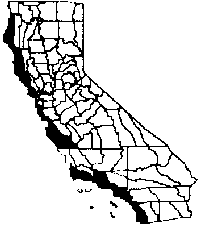
Distribution
|
åÊ
|
HOW DO I RECOGNIZE IT?
Distinctive features:
|
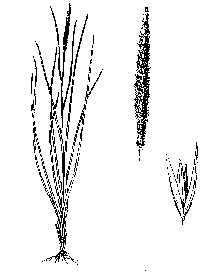
European beachgrass (Ammophila arenaria) is a perennial rhizomatous
grass occurring in coastal dunes. Stems are clumped, stiff, and upright. Leaves
are twelve to forty-four inches long, thick and waxy. The outer surface is
smooth and light green; the inner surface has ridges and is covered with a
whitish coating. Leaves are often rolled at the edges, covering ridges on the
inner side, and leaf tips are pointed and sharp. The inflorescence is
cylindrical, six to twelve inches long on stiff, erect stems. Rhizomes are
tough. Leaves are narrower, stiffer, and lighter in color than the native
beachgrass, Leymus mollis.
|
|
Description:
|
Poaceae. Stems: 20 to 48 in (50-120 cm). Leaves: involute,
12 to 44 in (40-110 cm) long and 0.1 to 0.25 in (2-5 mm) wide. Ligules 0.4
to 1.2 in (1-3 cm) long. In comparison, the introduced species A.
breviligulata, which is native to Atlantic and Great Lakes coastal dunes
and is only rarely found along the Pacific Coast, has ligules less than
0.25 in (5 mm) long. Inflorescence: in dense spike-like panicles, 6 to 12
in (15-30 cm) long and 0.8 in (2 cm) wide. Flowers: spikelets 0.4 to 0.5
in (10-13 mm) long, subsessile, laterally compressed, strongly keeled;
glumes +or- > floret, membranous, obtuse to acuminate, lower generally
1-veined, upper 3-veined; callus hairs 0.1 to 0.2 in (2-4 mm), tufted;
floret bisexual, breaking above glumes; lemma membranous, 0.3 to 0.4 in
(8-10 mm), 5-7 veined; palea membranous 0.3 to 0.4 in (8-10 mm) (Hickman
1993).
|
|
|
|
WHERE WOULD I FIND IT?
|
European beachgrass occurs on sandy coastal
dunes from British Columbia to San Diego County, California (Breckon and Barbour
1974, Barbour and Johnson 1977). The plant thrives in unstable dunes where there
is continuous sand accretion, but it is also found in stabilized dunes. While
European beachgrass appears to spread actively north of San Francisco, it is not
as aggressive to the south (Barbour et al. 1976, Barbour and Johnson 1977).
However, it is reported as invasive at Guadalupe-Nipomo Dunes in San Luis Obispo
County.
|
|
WHERE DID IT COME FROM AND HOW IS IT SPREAD?
|
European beachgrass is native to the coast of Europe and North
Africa, from Scandinavia south to the Mediterranean Sea, and from Great Britain
east to Egypt. It was first planted along the Pacific Coast of North America,
around San Francisco’s Golden Gate Park, in 1869. It has since been transplanted
elsewhere along the coast (Barbour 1970), and there may also have been
subsequent introductions from its native range. It was planted extensively to
stabilize dunes.
European beachgrass spreads almost exclusively by
rhizomes, which can extend laterally over 6.6 feet (2 m) in six months (Aptekar,
1999). Rhizomes are also washed by ocean currents to new sites, where new
populations can become established. The rhizomes can survive and sprout new
plants after being submerged in seawater for prolonged periods. Bud viability is
still 51.2 percent after seven days of submergence, and 8.5 percent after
thirteen days submergence (Aptekar, 1999).
|
|
WHAT PROBLEMS DOES IT CAUSE?
|
European beachgrass forms a dense cover that appears to exclude
many native taxa. Plant species diversity on beaches dominated by European
beachgrass is much less than that of beaches dominated by native beachgrass
(Breckon and Barbour 1974, Barbour et al. 1976, Pavlik 1983c, Boyd 1992). As
European beachgrass cover increases, the cover of native plant species decreases
significantly (Aptekar 1999).
Dunes dominated by European beachgrass
also have lower arthropod species diversity, and fewer rare arthropod species
than dunes dominated by native species (Slobodchikoff and Doyden 1977). The
reduction in the amount of open sand areas in dunes dominated by European
beachgrass has severely reduced nesting habitat for the federally listed
threatened western snowy plover (Charadrious alexandrinus) (Pickart and
Sawyer 1998).
European beachgrass directly threatens native plant
communities, including Leymus mollis dominated foredunes (Pitcher and
Russo 1988) and dune mat communities (Van Hook 1983, Pickart 1988, Pitcher and
Russo 1988, Buell et al. 1995, Wiedemann and Pickart 1996, Pickart and Sawyer
1998), as well as the endangered Menzies’ wallflower (Erysimum menziesii)
and other rare dune species (Van Hook 1983, Pickart and Sawyer
1998).
European beachgrass has changed beach topography, creating steep
foredunes where none were present prior to its introduction, and altering dune
formation to promote dunes that are parallel to the coast, whereas under native
grasses, dunes formed roughly perpendicular to the coast (Cooper 1967, Barbour
and Johnson 1977, Wiedemann and Pickart 1996).
|
|
HOW DOES IT GROW AND REPRODUCE?
|
European beachgrass primarily reproduces vegetatively
through rhizome growth. Plants are initially established by plantings
undertaken to stabilize dunes, and by rhizomes washing in on ocean
currents from other sites. Once plants are established, they expand their
territory through vigorous rhizome growth. European beachgrass rarely
becomes established by seed. Seedlings are occasionally found, but most
die from desiccation, burial, or erosion. Seedlings are most likely to
survive in dune slacks where the sand surface remains damp (Huiskes 1977,
Benecke 1990).
|
European beachgrass is able to withstand up to 3.3
feet (1 m) a year of sand burial (Huiskes 1979), which is greater than
what the native beachgrass, Leymus mollis, appears to tolerate.
Sand burial of European beachgrass promotes leaf and internode elongation,
as well as growth of vertical rhizomes from axillary buds on horizontal
rhizomes (Gemmell et al. 1953). In areas without sand accretion, it is
much less robust (Wallen 1980). European beachgrass uses nitrogen more
efficiently, and allocates more resources to producing leaves and shoots,
than does L. mollis (Pavlik 1983). Shoots grow most vigorously in
spring. Growth slows during winter, but does not cease entirely (Huiskes
1979).
|
(click on photos to view larger image)
|
|
European beachgrass is a rhizomatous perennial grass that
grows most vigorously under conditions of continued sand accretion, and
forms extensive monospecific stands. The plant produces both vertical and
horizontal rhizomes. New shoots arise mainly along the vertical rhizomes,
forming dense tufts of grass. Horizontal rhizomes are responsible for
lateral growth.
|
|
|
HOW CAN I GET RID OF IT?
|
|
|
Physical control:
|
Manual methods: European
beachgrass can be removed by intensive repeated digging. Successful manual
control at Lanphere-Christensen Dunes Preserve (Pickart and Sawyer 1998)
required weekly to monthly digging of European beachgrass from early spring
through fall. If sand was “sifted” with rakes to remove rhizome fragments for a
depth of 19.5 to thirty-nine inches (0.5 to 1 m) following digging, follow-up
treatment was not required the following year. If sand was not sifted following
digging, and plots were dug monthly or less frequently, a second year of monthly
digging was required. On foredunes, where European beachgrass grows more
vigorously than in inland stands, a third year of monthly digging was required.
In general, less follow-up digging was required when first-year treatments were
more frequent, more thorough, and/or larger or in less dense locations (so that
fewer plants re-invaded from surrounding
stands).
Mechanical
methods: Some attempts have been made at Oregon Dunes National
Recreation Area to remove European beachgrass with heavy machinery. In the most
ambitious attempt, European beachgrass was removed to a depth of approximately
one meter (3.3 feet). The removed material was buried and capped with up to one
meter of sand. Moderate resprouting occurred the following spring (Pickart and
Sawyer 1998).
Prescribed burning: Burning stimulates European
beachgrass to resprout, and so by itself does not appear to be effective in
eradicating it (Pickart and Sawyer 1998).
Flooding: Several
attempts have been made using salt water or seawater to eliminate European
beachgrass (Pickart and Sawyer, 1998). In small test plots in 1983 at
Lanphere-Christensen Dunes Preserve, seawater treatments were not effective and
rock salt treatments had inconclusive results. A large-scale project using
seawater irrigation to control European beachgrass on twenty-six acres (10.5 ha)
of the North Spit of Coos Bay, Oregon, in 1996 was not successful (Pickart,
pers. comm.).
|
|
Biological control:
|
Insects and fungi: No
insects or fungi have have been approved by the USDA for control of European
beachgrass in the United States. There is no recorded insect that feeds solely
on European beachgrass. Meromyza pratorum Meigen (Dipt., Chloropidae), a beetle,
feeds only on European beachgrass in western Europe, but it has been found
feeding on wheat in Russia and Italy. The larvae destroy vegetative points,
killing up to 30 to 40 percent of tillers (Huskies 1979). Many fungi have been
recorded as living on European beachgrass, but most of these are non-specific
saprophytes or weak parasites on dying parts of the plant.
Grazing:
Animals native to California beaches rarely graze on European beachgrass.
Even if an animal could be found that would graze on the plant, it would not be
an effective control, since European beachgrass resprouts from its numerous
below-ground buds and rhizomes.
|
|
Chemical control:
|
In experimental trials conducted in
northern California from 1991 to 1994, using a variety of herbicides, the only
foliar treatment that consistently reduced live European beachgrass cover by 90
percent or more was glyphosate (as Roundupå¨), applied at concentrations of 4
percent or 10 percent and mixed with 0.5 percent added surfactant (Citowettå¨ or
Silwet L-77å¨ were used) applied at 200 gallons per acre (Aptekar 1999).
Selective application of 33 percent glyphosate (as Roundupå¨) applied with a
wiper or with an herbicide sprayer had mixed results. In some instances it was
extremely effective at reducing European beachgrass cover, but in other
instances it had practically no effect. Experimental trials conducted by
Monsanto from 1992 to 1994 using Rodeoå¨ (glyphosate without surfactants) have
resulted in a label recommendation of 8 percent solution of Rodeoå¨ plus 0.5 to
1.5 percent nonionic surfactant on a spray-to-wet basis, applied during active
growth. For selective control, application of 33 percent glyphosate and 1 to 2.5
percent non-ionic surfactant, applied with a wiper to avoid non-target plants,
is recommended.
The liquid soil fumigant form of metham (as Vapamå¨) is
extremely effective in killing European beachgrass (Aptekar 1999). Applied at
label rate, it reduced European beachgrass by 98 to 100 percent, and it was
nearly as effective when applied at one-half and one-quarter the label rate.
However, there are significant disadvantages to metham. It is difficult to apply
and affects all soil organisms. A granular form of the metham, Basimidå¨, is easy
to apply, but is not very effective under dune conditions without sufficient
rain or irrigation to move the fumigant to the appropriate soil depth following
application, and it also would be detrimental to all soil
organisms.
|