
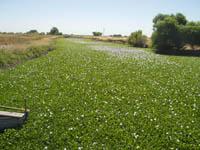
Water hyacinth chokes waterways
General Invasive Plant Information
Encycloweedia
Detailed information on plants regulated as noxious weeds by the California Department of Food and Agriculture
The Nature Conservancy Global Invasive Species Initiative
Visit the Management Library to view Elemental Stewardship Abstracts describing the biology and control information for many invasive plants. This site is also home to the Weed Control Methods Handbook, which outlines various control technologies in detail. And if you need to know what an invasive plant looks like, there are more than 900 photographs in the Photography Archive. (TNC closed this program. The website is now maintained as an archive but is not updated.)
Center for Invasive Species Management
The hub for management information in the western U.S. Includes plant biology and management information; education information; and publications. (CISM closed in 2015. The website is now maintained as an archive but is not updated.)
NatureServe Invasive Species Assessments
NatureServe is a non-profit conservation organization that provides the scientific information and tools needed to help guide effective conservation action. NatureServe and its network of natural heritage programs are the leading source for information about rare and endangered species and threatened ecosystems. Their invasive assessments are available by searching for a species on Nature Serve Explorer. The assessment protocol is available here.
Weed Control Information
For weed control and management information, please see the Invasive Plants Management page. The UC Davis Weed Research and Information Center also provides control information.
Blogs about Invasive Plants
Bugwood Invasive Blog
This blog is the work of the University of Georgia Center for Invasive Species and Ecosystem Health. The blog is updated weekly and covers all the latest research and policy surrounding invasive species.
CABI Invasive Blog
This blog is written by CABI, a non-profit organization working towards food security.
UC Weed Science
This blog, written by the UC Davis Weed Science program, mainly focuses on agricultural pests.
Weed Control Methods Handbook, The Nature Conservancy
Weed Control by Species
Elkhorn Slough National Estuarine Research Reserve. 2000. Contains control info for approx. 50 common species.
Weed Research and Information Center
University of California. Weed information, calendar of events, links to other weed sites
California’s Common Aquatic Weeds
- Photographs
- Herbicide Susceptibility
- Biological Control
- Mechanical Harvesting
- Habitat Manipulation
Statewide Integrated Pest Management (IPM) – University of California
UC Pest Management Guidelines. A database of UC recommended alternatives for controlling pests. Descriptions of UC IPM on-line resources, microcomputer software and databases, publications, slide sets and videos, training programs, and how to order or schedule them. You can also link to other UC pest management web sites from here.
USDA Agricultural Research Service, Exotic and Invasive Weeds Research
The mission of this unit is to provide national leadership in the development of novel methods for managing exotic and invasive weeds of rangelands and aquatic sites. Technology developed through this program provides the pest control methods used to devise effective and sustainable Integrated Pest Management (IPM) programs that support agricultural production and integrity of natural ecosystems in diverse situations throughout the country.
California Department of Pesticide Regulation
Information on products registered for use in California, as well as state regulations and permitting requirements.
US Environmental Protection Agency
Federal regulations, pesticide labels, risk assessments, safety guidelines for workers and homeowners. Spanish-language section and a page on chemical safety and integrated pest management for kids.
San Francisco Estuary Institute
A Practical Guidebook to the Control of Invasive Aquatic and Wetland Plants of the San Francisco Bay-Delta Region.
Organizational and Governmental Sites
California |
IPC and EPPC |
Other States |
Federal
Professional |
Restoration |
International
Many weed control projects in California are conducted by local Weed Management Areas, organized by county and overseen by the California Department of Food and Agriculture. For local regulations on noxious weeds, contact your county Agricultural Department.
California Organizations and Agencies
California Weed Management Areas
Weed Management Areas (WMAs) are local organizations that bring together landowners and managers (private, city, county, State, and Federal) in a county, multi-county, or other geographical area to coordinate efforts and expertise against common invasive weed species. This site includes links to local WMA websites with information on invasive plants of concern in your county. For local regulations on noxious weeds, contact your county Agricultural Department.
California Native Plant Society
Includes the CNPS Inventory of Rare and Endangered Plants, the CNPS Manual of California Vegetation, and other CNPS programs. It’s also a great place to learn about our native flora and to find out how to get involved in its preservation.
CalFlora
Online database of almost 8000 species. Species reports provide taxonomical, ecological,and distribution information. Includes photographs of native and non-native plants, a library of individual plant sightings, and a plant name library that allows you to search for synonyms for scientific names.
Invasive Spartina Project
A coordinated regional effort dedicated to preserving California’s coastal resources through the elimination of invasive species of Spartina (cordgrass).
CalWeed Database (California Noxious Weed Control Project Inventory)
A searchable database on noxious weed control projects in California, compiled by a committee of state and federal agencies. Submit your project’s information.
California Native Grasslands Association
Dedicated to promoting, preserving, and restoring the diversity of California’s native grasses and grassland ecosystems through education, advocacy, research, and stewardship
California Chaparral Field Institute
A loose association of scientists, naturalists and educators working to promote understanding of chaparral and improve communication between the scientific and firefighting communities. One of the major threats to this ecosystem is conversion to weedy grasslands.
San Diego Invasive Ornamental Plant Guide
This Guide is produced and distributed by the San Diego Chapter of the American Society of the Landscape Architects and the San Diego Chapter of the California Native Plant Society for the primary purpose of educating landscape professionals and the general-public regarding the cultivation, selection, use and management of non-native and/or invasive flora in San Diego regional landscapes.
Other IPC and EPPC Sites
National Association of Exotic Pest Plant Councils
An association encompassing Exotic Pest Plant and Invasive Plant Councils nationwide.
Southeast Exotic Pest Plant Council
Includes links to the state chapters of Alabama, Florida, Georgia, Tennessee, North Carolina, Mississippi, Kentucky, and South Carolina
Florida Exotic Pest Plant Council
The original EPPC, FlEPPC was founded in Florida in 1984 for the purpose of focusing attention on the impacts exotic pest plants have on biodiversity.
Michigan Invasive Plant Council
Invasive Plant Council of New York State
Other States’ Organizations
Center for Invasive Plant Management
A program of Montana State University (now archived), CIPM provides a wealth of information on all aspects of invasive plants. Website highlights include a how-to guide for starting a weed management area, funding announcements, an online textbook on invasive plant management, and extensive outreach materials.
Colorado Weed Management Association
CWMA is the single best source of noxious weed information in Colorado.
Whether you are looking for weed control assistance, or just enjoy Colorado’s natural beauty and would like to help keep it native and natural-the Colorado Weed Management Association can help.
University of Florida – Center for Aquatic and Invasive Plants
Information and pictures of some 35 invasive species, aquatic and terrestrial (in addition to a couple of hundred native species).
AgriGator – UF/IFAS Resources
West Florida Research and Education Center. The Jay Research and Education Center (JAY REC), part of the University of Florida’s Institute of Food and Agricultural Sciences (IFAS)
INVADERS Database System
For early detection and tracking of invasive alien plants and weedy natives. The INVADERS Database is a comprehensive database of exotic plant names and weed distribution records for five states in the northwestern United States. The spatial and temporal spread of weeds can be displayed using the historic distribution records in INVADERS. The INVADERS web site contains actual examples of how land management and weed regulatory agencies are using these data to improve their weed management programs. Noxious weed listings are provided for the 48 contiguous US states and six southern tier Canadian provinces.
Hawaiian Ecosystems at Risk (HEAR) Project
The goal of the HEAR project is to provide resources (technology, methods, and information) to resource managers statewide to aid the fight against invasive alien species.
Washington State Noxious Weed Control Board
The Washington State Noxious Weed Control Board advises the Washington State Department of Agriculture about noxious weed control in Washington State. It also serves as the state’s noxious weed coordination center.
Federal Agencies
National Invasive Species Information Center
A gateway to invasive species information covering Federal, State, local, and international sources.
USDA Plants Database
The PLANTS Database provides standardized information about the vascular plants, mosses, liverworts, hornworts, and lichens of the U.S. and its territories.
Weeds Gone Wild: Alien Plant Invaders of Natural Areas
A web-based, public education project of the Plant Conservation Alliance’s Alien Plant Working Group, providing fact sheets and other information on the threats and impacts of invasive alien plants to the native flora,
fauna, and natural ecosystems of the United States.
USDA Animal and Plant Health Inspection Service
USDA-APHIS. Activities and Organization, APHIS Forms, Publications, Fact Book, What’s New!, Subject Index, Guided Tour, Travelers’ Tips, APHIS Gopher, Phone Directory, Import-Export Directory
Extension Toxicology Network
A Pesticide Information Project of Cooperative Extension Offices of Cornell University, Michigan State University, Oregon State University, and University of California at Davis. Major support and funding was provided by the USDA/Extension Service/National Agricultural Pesticide Impact Assessment Program.
National Park Service Invasive Species Management
Control of invasive species is one of the most significant land management issues facing national parks. This page contains information about the Invasive and Non-Native Species program in our national parks.
Plant Conservation Alliance
The PCA is a consortium of ten federal government Member agencies and over 225 non-federal Cooperators representing various disciplines within the conservation field: biologists, botanists, habitat preservationists, horticulturists, resources management consultants, soil scientists,
special interest clubs, non-profit organizations, concerned citizens, nature lovers, and gardeners.
U.S. Fish and Wildlife Service Invasive Species Program
Activities to prevent and control invasive plant and animal species that severely impact the lands and waters of the United States, including resources managed within the National Wildlife Refuge System, have become a priority for the U.S. Fish and Wildlife Service as we expand our efforts to conserve and protect our nation’s native fish and wildlife habitats.
National Invasive Species Council (U.S. Dept. of the Interior)
The overarching duty of the Council is to provide the high-level vision and leadership necessary to sustain and expand Federal efforts to safeguard interests of the United States by preventing, eradicating, and controlling invasive species, as well as restoring ecosystems and other assets impacted by invasive species.
Southwest Exotic Plant Information Clearinghouse (USGS)
Organizes information from the southwestern US into one web location. Includes weed species profiles.
Professional Organizations
WSSA-Weed Science Society of America
WSSA Information about Weeds, Herbicides, and Other Weed Sciences Related Pages Mail to System Operator, Dave Pike. Page Maintained by Nathan L. Sandland.
California Weed Science Society
Dedicated to promoting the research, education, and regulatory aspects of weed science. This site includes newsletter and proceedings from past symposia.
North American Weed Management Association
A network of public and private professional weed managers who are involved in implementing any phase of county, municipal, district, state, provincial, or federal noxious weed law. Organizes National Invasive Weeds Awareness Weed in Washington, D.C. each year.
Environmental Science
A guide to starting your career as an environmental scientist, including: average salaries, common work environments, education requirements, finding college programs, and job possibilities.
Restoration Organizations
California Society for Ecological Restoration
A non-profit, membership based organization dedicated to the purpose of bringing about the recovery of damaged California ecosystems.
Wildlands Restoration Team
The Wildlands Restoration Team is a volunter based organization dedicated to preserving the rich biological diversity of the Santa Cruz Mountains Since its inception in 1990, thousands of people have given their time and resources to help restore this priceless wild habitat.
International Organizations
Australian Government Invasive Species Program
Similar to the U.S. www.invasivespeciesinfo.gov page, this site has information on invasive species in Australia, including scientific reports, policies, and control information.
Global Invasive Species Programme
GISP, the Global Invasive Species Programme, was established in 1997 to address global threats caused by Invasive Alien Species, and to provide support to the implementation of Article 8(h) of the Convention on Biological Diversity.