

Celebrating 20 great years!
Tahoe City, California, October 2011
Invasive Plants and Ecological Change
View full program with abstracts.
View Proceedings
Links below are pdf files converted from Powerpoint presentations. Download Adobe Acrobat Reader to view them.
Session 1. Ecological Change
- Nuance, naysayers and twenty years of studying species impacts. Carla D’Antonio, UC Santa Barbara
- The ghost of invasions past: the soil legacy of invasive plant species. Katharine Suding, UC Berkeley
- Smog is fertilizer: atmospheric nitrogen deposition drives weed invasions and biodiversity. Stuart Weiss, Creekside Center for Earth Observations
- Fire, climate change, and opportunities for invasion. Max Moritz, UC Berkeley
Session 2. Membership Meeting
- Sustainable forests, healthy communities and vibrant rural economies. Kim Carr, Sierra Nevada Conservancy
- New and expanding weeds in California. Dean Kelch, CA Dept. of Food and Agriculture
Session 3. Student Paper Contest
- Dittrichia graveolens – a study of invasive plant biology with a focus on management. Rachel Brownsey, UC Davis
- Alteration of nitrogen cycling processes by exotic annuals in a California grassland. Chelsea Carey, UC Merced
- How does light attenuation affect giant reed (Arundo donax) establishment? Kai Palenscar, UC Riverside
- The importance of landscape context in invasive plant patterns within conservation linkages. Marit Wilkerson, UC Davis
Session 4. Prevention
- Working with mineral materials producers and suppliers – Got Clean Gravel? Wendy West, UC Cooperative Extension, and Garrett Dickman, Yosemite NP
- Prevention BMPs for invasive plant managers. Jen Stern, Cal-IPC
- Challenges to early detection and rapid response – spotted knapweed eradication: building successful partnerships between local, federal, and private entities. LeeAnne Mila, El Dorado Co. Dept. of Agriculture
Session 5. Spatial Data
- Using public domain remotely sensed data to predict Taeniatherum caput-medusae (medusahead) infestations, a case study from the central California foothills. Jim Alford, CA Dept. of Fish & Game
- Invasive plant management in California State Parks. Ramona Robison, CA State Parks
- Using distribution information to understand and conserve California flora: recent results and prospects for further future improvement. Daniel Gluesenkamp, Calflora
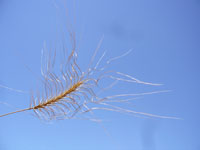
Medusahead (Taeniatherum caput-medusae)
Photo: Zoya Akulova, 2011 photo contest
Session 6. Climate Change in the Sierra Nevada
- Climate change in the Sierra Nevada; Processes, projections, and adaptation options.
Constance Millar, Pacific SW Research Station, USDA Forest Service - Effects of changing precipitation patterns on the spread of Bromus tectorum L. in the eastern Sierra Nevada and implications for management. Amy Concilio, UC Santa Cruz
- Predicting the spread of invasive plants in the Sierra Nevada with climate change. Elizabeth Brusati, Cal-IPC
Session 7. Pesticide Laws and Regulations
- Records and storage requirements for pesticide applicators. Charlene Carveth, El Dorado and Alpine Co. Agricultural Commissioner’s Office
- The Pesticide Use Monitoring Inspection. LeeAnne Mila, El Dorado and Alpine Co. Agricultural Commissioner’s Office (The first two talks were combined into one presentation.)
- Best Management Practices establishing a closed chain of custody for herbicide use in the utility vegetation management industry, laws and regulations for utility vegetation managers. Nelsen Money, NRM-VMS
- Recent court orders and injunctions for the protection of endangered species. Polo Moreno, California Department of Pesticide Regulation, and Edmund Duarte, Alameda County Department of Agriculture
Session 8. Management and Restoration
- Sustainable solutions to cross restoration thresholds and build ecological resilience: Orange County Invasive Management project. Sara Jo Dickens, UC Berkeley
- Tipping the balance: using natives to combat weeds and promote ecological resilience of riparian restoration. Hejo Tjarks, River Partners
- Evaluating distribution and prevalence of non-native vegetation percent cover in a Southern California wetland and its application to inform habitat restoration and non-native vegetation control. Elena D. Tuttle, The Santa Monica Bay Restoration Commission
- Effectiveness of aquatic invasive plant control in Emerald Bay, Lake Tahoe. Dan Shaw, CA State Parks
- Containing the spread of invasive plants by implementing a comprehensive roadside weed removal initiative. Tony Summers, Catalina Island Conservancy
- Prioritizing and promoting region-wide invasive plant management: a report on successes from the Bay Area Early Detection Network. Mike Perlmutter, BAEDN
Session 9. Examining Broader Impacts
- Designing wildlife avoidance into invasive species control projects. Rick Austin, Santa Clara Valley Water District
- Invasive Spartina Project at a turning point: eradication on the horizon, reconciling clapper rail impacts, and charting a course towards tidal marsh revegetation with native cordgrass. Drew Kerr, Invasive Spartina Project
- Distribution and impacts of Arundo donax from Monterey to Tijuana. Jason Giessow, DENDRA, Inc.
- Cost-sensitive risk assessment for invasive plants in the United States. Michael Springborn, UC Davis
Session 10. Science, Management, and Policy Interactions
- Emerging large landscape conservation initiatives create new opportunities to control invasive plants. Steven Frisch, Sierra Business Council
- Science, policy, and management interactions: The past is not a template for the future of the national parks. Dave Graber, National Park Service
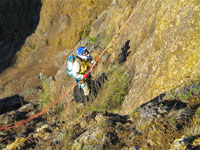
Rapelling to remove invasive plants
Photo: Rolland Mathers, Shelterbelt, 2011 photo contest
Posters
- The interaction of soil surface gravel content and nitrogen deposition on the seedbank of the invasive grasses Schismus arabicus and Schismus barbatus in the northwest Sonoran Desert. Michael D. Bell, UC Riverside
- Invasive aquatic weeds: Implications for mosquito and vector management activities. C. E. Blair, Mosquito and Vector Management District of Santa Barbara County
- Performance attributes of aminocyclopyrachlor herbicide in controlling invasive plants. John Cantlon, DuPont Land Management
- A predictive model of Bromus tectorum occurrence in Yosemite National Park. Steven Del Favero, Yosemite National Park
- A common data model for weed monitoring data. Deanne DiPietro, Sonoma Ecology Center
- Monitoring environmental responses to Tamarix biocontrol and ecosystem recovery in the Virgin River watershed. Tom Dudley, UC Santa Barbara
- Mapping, monitoring and removing medusahead. Joan Dudney, Arastradero Preserve Stewardship Project
- Mapping invasive weeds: scaling up and down for different end user scenarios. Ingrid Hogle, San Francisco Estuary Invasive Spartina Project
- Tulare County WMA yellow starthistle control program. Andrew L. Isner and Jim Sullins, UC Cooperative Extension, Tulare Co.
- Public-private cooperation results in improved restoration of reed canarygrass (Phalaris arundinacea) infested areas. Jonathan Humphrey, Sequoia and Kings Canyon National Parks
- The evolution of arundo removal efforts on Camp Pendleton. Benjamin M. Lardiere, MCB Camp Pendleton
- Mechanical control of yellow starthistle: impacts on target and non-target vegetation. Virginia Matzek, California State University, Sacramento
- The effect of invasive Chrysanthemum coronarium on a coastal sage scrub arthropod community in Southern California. Kim-Chi Nguyen, UC San Diego, Scripps Institution of Oceanography
- Eradicating Algerian sea lavender (Limonium ramosissimum) from San Francisco Bay wetlands. Mike Perlmutter, Bay Area Early Detection Network
- Population expansion and regional management of red sesbania (Sesbania punicea) in California. Ramona A. Robison, California Department of Parks and Recreation
- Evaluating the effects of horizontal and vertical mulches for restoration of a degraded site in the Mojave Desert: first year findings. Heather Schneider, US Geological Survey
- Results from four years of early detection invasive plant monitoring in Golden Gate National Recreation Area. Robert Steers, National Park Service
- Comparison of four herbicide treatments on Oxalis pes-caprae. Lewis Stringer, Presidio Trust
- Evaluation of control techniques for velvetgrass (Holcus lanatus) in the Kern Canyon of Sequoia National Park. Rich Thiel, Sequoia and Kings Canyon National Parks
- Progress in the restoration of the habitat of fountain thistle (Cirsium fontinale) invaded by jubatagrass (Cortaderia jubata). Don Thomas, San Francisco Public Utilities Commission
- Developing, evaluating and prioritizing alternatives for noxious weed management using a Weed Matrix. Dean Tonenna, Bureau of Land Management
Discussion Group Notes
- Prioritization schemes for weed management
- Licensing and contracting mechanisms for getting work done
- State-level strategies for rapid response and management of aquatic weeds: new approach needed?
- Invasive plant Integrated Pest Management
- Integrating the Student Chapter into Cal-IPC
- Prevention efforts across the state: weed-free materials and prevention Best Management Practices
Symposia Archive
Presentations, proceedings and working group notes for previous years’ symposia:
2010 |
2009 |
2008 |
2007 |
2006 |
2005 |
2004 |
2003 |
2000-2002 |
1999 |
1998 |
1997 |
1996 |
1995