
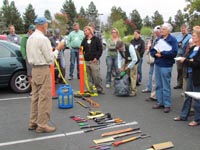
Tool tailgate with Ken Moore
Photo: JP Marie
Bay to Basin: Coordinating Response to Invasive Plants across California
October 11-12, 2012, Rohnert Park
View full program and abstracts.
Links below are pdf files converted from Powerpoint presentations.
Session 1. Ecological Change
- Landscape management practices in Late Holocene California: implications for contemporary stewardship. Kent Lightfoot, UC Berkeley
- The California Landscape Conservation Cooperative. Christine Howell, USDA Forest Service
- The Bay Area Upland Habitat Goals Project. Stuart Weiss, Creekside Center for Earth Observations
Session 2. Annual Member Meeting
- New and expanding weeds in California. Dean Kelch, CA Dept. of Food and Agriculture
- Battle of the marshes: invasive plants and wetland restoration North and South. Sam Schuchat, California State Coastal Conservancy
Session 3. Tools and Strategies for Effective Invasive Plant Management
- Operational performance of a Herbicide Ballistic Technology (HBT) helicopter platform targeting incipient populations of miconia (Miconia calvescens) in Hawaiian watersheds. James Leary, University of Hawaii
- Use and effectiveness of landscape-scale surveys in developing weed management strategy. Jutta Burger, Irvine Ranch Conservancy
- Seed bank limitation, management and overcoming cycles of exotic plants species hierarchical shifts. Sara Jo Dickens, UC Berkeley
- The Butterfly Effect: Assessing herbicide impacts to invertebrates. Joel Trumbo, California Dept. of Fish & Game (presented by Julie Horenstein)
Session 4. Student Papers
- Development and validation of a more accurate weed risk assessment tool for evaluating the invasive potential of ornamental plants. Christiana Conser, UC Davis
- Effects of soil inocula on the growth responses of native annual forbs and the invasive annual grass, Bromus diandrus. Bridget Hilbig, UC Riverside
- Divergence in acquisition and allocation patterns among native and introduced populations of an annual grass contribute to invasiveness. Matt O’Neill, UC Riverside
Session 5. Managing Grassland Weeds
- Preserving serpentine grasslands: ten years of research and management to
control barbed goatgrass (Aegilops triuncialis) at the McLaughlin Reserve. Paul Aigner, UC Davis - Controlling the spread of velvet grass (Holcus lanatus) in California coastal
prairies: the benefits and constraints of five management techniques. Michelle Cooper, UC Bodega Marine Reserve - Pre-emergent control of medusahead on California annual rangelands with aminopyralid. Guy Kyser, UC Davis
- Control of yellow starthistle and reintroduction of native perennial bunchgrasses. Jennifer Tiehm, Pinnacles
National Monument
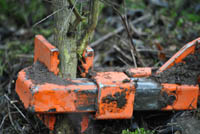
Weed wrench clenching Scotch broom
Photo: William Welsch, 2012 photo contest
Session 6. Working Across Taxa
- Plant-microbe interactions and plant invasions.
Ingrid Parker, UC Santa Cruz - Native pollinators and invasive plants: Implications for agriculture and restoration. Victoria Wojcik, Pollinator Partnership
- Mutualisms between native and non-native species: Global trends and Californian case studies. Clare Aslan, Arizona-Sonora Desert Museum
Session 7. Pesticide Laws and Regulations
- Laws and regulations for pesticide applicators.Andrew Smith, Sonoma County Dept. of Agriculture
- Field safety for pesticide applicators. Mark Heath, Shelterbelt Builders
- Calibration of herbicide applications for natural areas. Guy Kyser, UC Davis
- California’s revised NPDES aquatic pesticide permit update: What’s new? Mike Blankinship, Blankinship and Assoc.
Session 8. Invasive Plant Management and Programs I
- Use of spatially-referenced inventory data to inform management of Lepidium
latifolium in tidal marshlands of the San Francisco Estuary. Giselle Block, USFWS - California’s RCDs: Partnering to combat invasive plants statewide. Karen Buhr,
California Assoc. of Resource Conservation Districts - Controlling harding grass (Phalaris aquatica) in a grassland setting: An interim report. Stassia Samuels and Laura Julian, Redwood National amd State Parks
- Controlling invasive plants in Pacific Gas and Electric’s hydroelectric watersheds. Shannon Dinis, Pacific Gas and Electric Company
- Long-term effects of burn severity and fire frequency on vegetation and seedbanks in the Mojave Desert. Rod Klinger, USGS
Session 9. Invasive Plant Management and Programs II
- Coordinated regional strategy in the central Sierra using CalWeedMapper. Wendy West, UC Cooperative Extension
- Restoration, flood conveyance, and stormwater management: Emerging criteria for vegetation management in urban streams and flood-prone areas. Mark Newhouser, Sonoma Ecology Center (presentation not available)
- Reliably reducing milk thistle (Silybum marianum) to zero density: A treatment model for annual weeds with plastic life cycles. Tony Summers, Catalina Island Conservancy
- European dune grass control: 15 years of adaptive management. Tim Hyland, California State Parks
Session 10. Working Across Time (panel discussion)
- In the coming decades, climate change will make “restoration” even more of a moving target.
Talk of “novel ecosystems” and “assisted migration” is growing more common. A panel of
practitioners and researchers will discuss the challenge of setting goals for research and
stewardship. Panelists’ summary.
Posters
- Assessing multiple treatment methods to control Festuca arundinacea using prescribed
burning, herbicide, brushcutting and hydromechanical obliteration (H_M_O). Maria Alvarez, Golden Gate National
Recreation Area - Invasive aquatic weeds: Implications for mosquito and vector management activities. C. E. Blair, Mosquito and Vector Management District of Santa Barbara County
- Slope instability increased by Cryptomaria japonica in Sichuan earthquake zone. Carla Bossard, St. Mary’s College of California
- The California firewood task force: A multiagency response to forest health threats posed by movement of firewood.Susan Frankel, US Forest Service
- Searching for a silver bullet: reducing the invasive Sahara mustard while preserving native wildflowers. Chris McDonald, UC Cooperative Extension,
Riverside - Setting regional strategies for invasive plant management using CalWeedMapper. Dana Morawitz, Cal-IPC
- Is mastication plus prescribed burning an effective control method for multi-acre medusahead (Elymus caput-medusae) infestations? Courtney Rowe, Plumas National Forest
- Is imazapyr an effective alternative to glyphosate for the control of jubatagrass? Don Thomas, San Francisco Public Utilities Commission
- Differential terrestrial pulmonate gastropod species composition inside and outside eucalyptus forests. Michael Walgren, California Department of Parks and Recreation
- Preventing the introduction and spread of invasive weeds: engaging the construction, aggregate, and utility industries and land managers. Wendy West, UC Cooperative Extension
Discussion Groups
- New Weed Control Handbook
- Prevention Best Management Practices
- Reducing the potential for herbicide impacts on wildlife (Herbicide Survey Results | Which Herbicide? )
- Seeking funding in a competitive environment (Introduction | NRCS | Wildlife Conservation Board | Wetlands Recovery Project)
- Wild pollinators and weeds
- A coordinated statewide management strategy for stinkwort (Dittrichia graveolens) (Presentation | Notes)
- Updating GeoWeed (Presentation)
Symposia Archive
Presentations, proceedings and working group notes for previous years’ symposia:
2011 |
2010 |
2009 |
2008 |
2007 |
2006 |
2005 |
2004 |
2003 |
2000-2002 |
1999 |
1998 |
1997 |
1996 |
1995