|
Hedera helix
|
|
|
|
Scientific name
|
Hedera helix
|
|
Additional name information:
|
L.
|
|
Common name
|
English ivy
|
|
Synonymous scientific names
|
none known
|
|
Closely related California natives
|
0
|
|
Closely related California non-natives:
|
0
|
|
Listed
|
CalEPPC List A-1,CDFA nl
|
|
By:
|
Sarah Reichard
|
|
Distribution
|
|
|
HOW DO I RECOGNIZE IT?
Distinctive features:
|
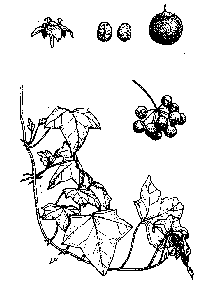
English ivy (Hedera helix) is the
familiar vining plant often allowed to grow up building walls. It has two forms:
an evergreen woody vine and an evergreen shrub. Both forms have deep green,
glossy, leathery leaves. Vining plants do not produce flowers or fruits, and
their leaves have lighter-colored veins and three to five lobes. Upright shrubby
plants may produce flowers and fruits, and their leaves are ovate rather than
lobed. In both forms the leaves may have a strong odor when crushed. The white
flowers are in clusters on the ends of stems produced in fall, and the fruits
are dark blue or purplish drupes. English ivy may be distinguished from grape
vines (Vitis sp.) and Ampelopsis species by its evergreen leaves, which are not
hairy or fuzzy (pubescent), and by vines that have no tendrils. It differs from
cape ivy (Delairea odorata) in having leaves that are evergreen in all climates,
with a deep cleft at the leaf base that makes the lower lobes appear larger than
the others. Cape ivy may also be distinguished from this species by its small,
yellow composite flowers.
åÊ
|
|
Description:
|
| Araliaceae. Perennial, evergreen woody vine to 99 ft (30 m) (juvenile plant) or shrub (adult plant). Stems: creeping juvenile stems have roots at leaf nodes with adventitious rootlets that allow the plant to climb vertical surfaces by adhering to, but not penetrating, bark and brick. Adult flowering stems erect and non-climbing. Leaves: leathery, simple, and alternate. On juvenile plants leaves have 3-5 lobes and are 1.6-4 in (4-10 cm) long and about as wide. Terminal lobe about as broad as long; the two basal lobes may be reduced or absent. Lobes often more pronounced on leaves of climbing stems. |
|
Leaf base cordate and veins markedly lighter
in color. Leaves on flowering stems mostly unlobed, ovate to rhombic, base
shallowly cordate to cuneate, and veins slightly lighter in color. Petioles on
both forms about as long as the leaf. Young shoots, leaves, and peduncles
covered with stellate hairs and scales; older shoots and leaves glabrous.
Inflorescence: a raceme that appears umbellate. Flowers: bisexual, radial,
usually 0.2-0.3 in (5-7 mm) across, with 5 sepals fused at the base and
persistent but small. There are 5 separate white to yellowish green petals;
stamens usually 5 and alternate with petals; 1 style with 5-lobed stigma; ovary
inferior. Fruits: berry-like drupe about 0.24-0.36 in (6-9 mm) in diameter
containing 4-5 seeds; drupe usually dark blue to black, lighter on some
cultivated varieties. English ivy flowers in fall, and fruits are produced the
following spring in April and May (Putz and Mooney 1991).
åÊ
|
|
WHERE WOULD I FIND IT?
|
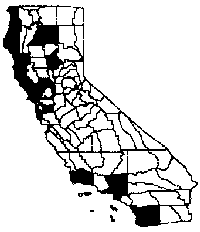
English ivy is found in northern California
forests south to at least Santa Cruz. It has also been observed in Shasta and
Butte counties and along the south coast from Santa Barbara County to San Diego.
It is a serious problem in the coastal Pacific Northwest from central Oregon
into British Columbia. On the eastern seaboard it also spreads into woods,
particularly from Virginia north to New York. English ivy is generally found in
open forests, especially those with a deciduous component, from sea level to
3,300 feet (1,000 m) elevation. It is especially common in forests near urban
areas. It climbs up tree trunks and along branches into the canopy and may also
cover the ground. English ivy will invade riparian zones where flooding has
disturbed the soil, but it does not grow well in areas where the water table is
high and soil is waterlogged (Thomas 1980). It grows well in acid and basic
soils.
åÊ
|
|
WHERE DID IT COME FROM AND HOW IS IT SPREAD?
|
English ivy is native to England, Ireland,
the Mediterranean region, and northern Europe west to the Caucasus Mountains. In
its native range English ivy is widespread and usually found in woods and along
rocky areas. It is often considered a weedy pest in its native range (Wyman
1954). It was introduced into North America in early colonial times as an
ornamental (Wyman 1969). English ivy has been planted to control soil erosion in
many parts of the United States because of its habit of rooting at the leaf
nodes along the stem. It is perhaps the best known of all evergreen vines in
cultivation. Birds disseminate the seeds. Once established, it spreads quickly
by vegetative means.
åÊ
|
|
WHAT PROBLEMS DOES IT CAUSE?
|
English ivy can alter natural succession
patterns in forests. It forms ÛÏivy desertsÛ of vigorous vines in forests where
nothing else seems able to compete. It inhibits regeneration of understory
plants, including forest wildflowers and new trees and shrubs (Thomas 1980). By
blocking regeneration in forests, it jeopardizes their long-term persistence.
English ivy also kills trees in the understory and overstory by shading them out
(Thomas 1980). It tends to grow up tree trunks into branches, especially those
of deciduous trees. The increased winter light under deciduous trees apparently
allows this evergreen vine to grow rapidly upward in winter (Thomas 1980). Once
in the canopy, English ivy can shade out deciduous foliage during summer months,
suppressing the growth of the tree that supports it. As the tree dies back, its
increasingly open crown allows the vine to grow even more (Thomas 1980). In
addition to shading, the additional weight of water and/or ice on the evergreen
ivy leaves may increase storm damage to trees, especially in the presence of
high winds. This effect has been observed in trees infested with Vitis sp. in
Connecticut (Siccama et al. 1976).
English ivy may replace species used by native wildlife. Its
leaf litter adds nitrogen to the soil, which may disadvantage native species
that compete best under lower nutrient levels (Tremolieres et al. 1988). The sap
can cause dermatitis in some people, and both berries and leaves are toxic
(Hickman 1993).
åÊ
|
|
HOW DOES IT GROW AND REPRODUCE?
|
While vegetative reproduction is a key to the success of English ivy, the plant also reproduces prolifically by seed. English ivy flowers in fall, and fruits are produced the following spring in April and May. The juvenile period is long, often ten years or more, but when it becomes reproductive, it produces large numbers of bisexual flowers
in fall that are attractive to pollinating bees. Seeds ripen the following year, and on average about 70 percent are viable (Dirr and Heuser 1987). English ivy seed has a hard coat that must be scarified before it can germinate, a condition easily met as the seed passes through the digestive systems of birds that disperse the fruits. The fruits are eaten by several species of birds. English ivy reproduces vegetatively by adventitious roots along the stem and may regenerate from stem fragments if they remain in contact with the soil. The vines can persist a long time; there have been reports of a vine that was 433 years old (Putz and Mooney 1991).
|
English ivy grows
as a woody vine when young, becoming increasingly shrubby as the plant
becomes reproductive. Because its leaves are evergreen, it can
photosynthesize year-round and
will grow rapidly if unchecked. Its ability to climb structures using adventitious
roots suggests that it is well adapted to establishment
in late successional forests (Carter and Teramura 1988).
|
(click on photos to view larger image)
|
The root system is shallow.
Growth in the adult shrub form is slower. English ivy tolerates shade, but its
growth is stimulated by light. Thomas (1980) found that in heavy shade (4 to 7
percent of full sunlight) English ivy survived but began to slowly decline,
while under 65 to 68 percent of full sunlight the plant flourished.
|
|
HOW CAN I GET RID OF IT?
|
Control of English ivy has not received
sufficient attention or research. Research in the past has focused on
establishing new cultivars rather than on controlling or eliminating the
plant.
åÊ
|
|
Physical control:
|
Manual/mechanical: The best method for
controlling English ivy may be hand removal of vines using pruners to cut the
vines and then pulling the plants up from the forest floor and down from the
trees. Removing and killing vines that spread up into trees is especially
important because the fertile branches grow primarily on upright portions of the
vine. If vines are cut at the base of the tree the upper portions will die
quickly but may persist on the tree for some time; vines on the ground around
the tree should also be removed to prevent regrowth up the tree. Care should be
taken to minimize disturbance during removal. If the forest floor becomes
disrupted, appropriate native species should be planted on the site to inhibit
reinfestation by English ivy or another invader (Humphries et al. 1991).
Prescribed burning: An extreme method that has been used with
some success is to burn ivy plants and resprouts with a blow torch at regular
intervals; the energy used by the plant to regrow will eventually be depleted.
Obviously, this approach requires considerable caution. No other attempts to use
fire to control English ivy have been reported.
åÊ
|
|
Biological control:
|
Insects and fungi: There have been no
attempts to introduce biological control agents, and it is extremely unlikely
that such agents will ever be used. English ivy is an important landscape plant
and has strong support from the horticultural community, including a society
dedicated to its study and promotion (the American Ivy Society).
Grazing: The palatability of English ivy to grazing animals is
unrecorded.
åÊ
|
|
Chemical control:
|
English ivy is tolerant of preemergence herbicides (Derr 1992).
Its waxy leaves make effective application of post-emergent herbicides
difficult, even when a surfactant is added. Glyphosate (as Round-upå¨) applied at
a rate of 2.7 lb/acre effectively controlled young plants, especially in early
spring (Neal and Skroch 1985), but tests on more mature plants suggested that
adult upright English ivy is tolerant of this herbicide. This was true even when
surfactants, high application rates (4 lb/acre), and second applications were
used (Derr 1993), although growth may be retarded as much as 60 percent.
Workers at the Washington Park Arboretum in Seattle have had
some success using a string trimmer to remove most of the leaves and young stems
and then immediately spraying triclopyr (as Garlon 4å¨) at a rate of 6.5 oz/gal
plus a surfactant. Two years after application the treated plants were dead,
although the area was being reinfested from surrounding populations. In smaller
infestations the herbicide can be brushed onto cut stems. Check with a certified
herbicide applicator for concentrations of these herbicides currently registered
for use in California.
åÊ
|