|
Digitalis purpurea
|
|
|
|
Scientific name
|
Digitalis purpurea
|
|
Additional name information:
|
L.
|
|
Common name
|
foxglove, purple foxglove
|
|
Synonymous scientific names
|
none known
|
|
Closely related California natives
|
0
|
|
Closely related California non-natives:
|
0
|
|
Listed
|
CalEPPC Need more information,CDFA nl
|
|
Distribution
|
|
|
HOW DO I RECOGNIZE IT?
Distinctive features:
|
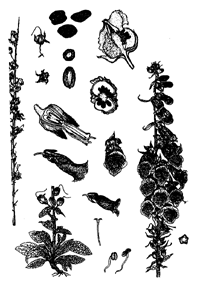
Foxglove (Digitalis purpurea) is
an erect, knee-high to head-high herbaceous perennial with a basal rosette of
leaves. In its second growing season it produces a leafy stock bearing a column
of long, bell-shaped, nodding flowers on one side. Flowers are generally pinkish
purple or white, with spots on the inside lower portion.
åÊ
|
|
Description:
|
| Scrophulariaceae. Biennial or perennial herb. Stems: 1-5 ft (0.3-1.8 m) from taprooted caudex, branched above. Leaves: lanceolate to ovate, 4-12 in (10-30 cm) long, evenly spaced but reduced upward 2-8+ in (5-20+ cm), ovate, margins deeply dissected, upper surface green and soft-hairy, lower surface gray-tomentose, lower leaves soon deciduous. Inflorescence: pedicel 0.5-1 in (6-25 mm), spike 1-4 ft (30-130 cm), tomentose. Flowers: calyx lobes |
|
|
|
WHERE WOULD I FIND IT?
|
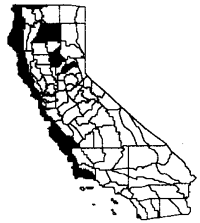
Foxglove is found along the California
coast northward from Santa Barbara County, infesting moist meadows and
roadsides. It is also reported from the northern Sierra Nevada foothills. A
cultivated ornamental, it is often found escaping. It grows in full sun to part
shade, in any well drained, fertile, acid soil in open woodland, pastures,
roadsides, and disturbed places at less than 3,000 feet (1000 m) elevation. It
thrives throughout the United States except in southern Florida and along the
Gulf Coast, where it is suppressed by high humidity.
åÊ
|
|
WHERE DID IT COME FROM AND HOW IS IT SPREAD?
|
Native to Europe (especially western
Europe), the Mediterranean, and northwest Africa, foxglove has been introduced
to many areas as an ornamental and medicinal plant. By 1940 it was established
in Humboldt and Mendocino counties (Robbins 1940). It escapes cultivation, and
seeds are dispersed by wind and water.
åÊ
|
|
WHAT PROBLEMS DOES IT CAUSE?
|
A source of the cardiac glycoside
digitalis, a medically important heart stimulant, all parts of the plant are
toxic. Foxglove is lethal to animals consuming small amounts of fresh or dried
material (Scott 1997). It readily colonizes areas of soil disturbance, forming
dense patches that displace natural vegetation.
åÊ
|
|
HOW DOES IT GROW AND REPRODUCE?
|
|
Foxglove reproduces only by seed. In the spring of the second year of growth, it rapidly produces stalks two to five feet (1-2 m) tall, lined with blossoms. Flowers mature in early summer, producing abundant seeds. Seeds are dispersed throughout the summer and remain viable in the soil at least five years (Scott 1997). Sprouts of the small seeds are not able to penetrate turf to any depth. Soil disturbance greatly increases establishment of seedlings. Stalks die back in winter.
|
(click on photos to view larger image)
|
|
|
HOW CAN I GET RID OF IT?
|
Sites will need to be monitored for five to
ten years. Control efforts are required for at least five years.
åÊ
|
|
Physical control:
|
Manual methods: Hand pulling of stalks is
effective. In spring, while soils are moist, stalks and root masses are easily
pulled from the ground. Pulled material must be removed from the site and
destroyed (flower stalks left on site will continue to mature and release
thousands of seeds). It is easy to strip flowers from the stalks, and little
additional effort is needed to pull up the entire plant. If flower stalks are
cut back before seeds ripen, the plant can bloom again in mid- to late summer.
Therefore, above-ground treatments such as clipping and mowing may be
counter-productive unless repeated before resprouts have time to produce seed.
Workers must protect themselves from extended contact with the poisonous
leaves.
Prescribed burning: Fire associated with other management
programs is problematic, since stands of foxglove are not a good fuel source.
Also, habitat in which foxglove typically becomes established does not contain
enough fuel to sustain a fire long enough to kill the plant. Smoke from burning
leaves is toxic and has caused injury to workers on control projects (Scott
1997).
åÊ
|
|
Biological control:
|
Foxglove is valuable commercially in
horticulture, so biological control has not been pursued.
åÊ
|
|
Chemical control:
|
Herbicide trials were conducted in late
summer and early spring by Scott (1997) on infestations of Digitalis lanata in
Wilson county, Kansas. Metsulfuron methyl (as Escortå¨) at label strength and
triclopyr (Garlonå¨) at 2 pts/acre showed some effect on the plants but did not
kill all of them. Herbicides may work, but hand pulling is more efficient and
effective with fewer effects on non-target plants.
åÊ
|