|
Bellardia trixago
|
|
|
|
Scientific name
|
Bellardia trixago
|
|
Additional name information:
|
L.
|
|
Common name
|
Mediterranean linseed, garden bellardia
|
|
Synonymous scientific names
|
Bartsia trixago L.
|
|
Closely related California natives
|
0
|
|
Closely related California non-natives:
|
0
|
|
Listed
|
CalEPPC List B,CDFA nl
|
|
By:
|
Carla Bossard,John M. Randall
|
|
Distribution
|
|
|
HOW DO I RECOGNIZE IT?
Distinctive features:
|
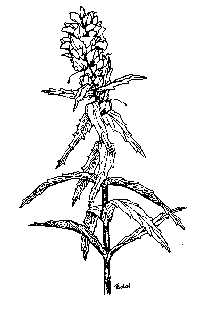
Mediterranean linseed (Bellardia trixago) is a glandular-hairy
annual in the snapdragon family, with erect stems six to twenty inches tall and
small, opposite, narrow leaves with coarsely toothed or scalloped margins. The
small flowers are arranged in spike-like racemes with leaf-like bracts between
the individual flowers, which have a purple hood-like upper lip (galea) and
white lower lip. Mediterranean linseed is a green, photosynthetic plant that
must parasitize other plants for carbohydrates in order to develop normally and
flower (Carafa et al. 1980).
|
|
Description:
|
Scrophulariaceae. Small annual herb with
erect, generally simple stems. Plants glandular-hairy 6-29 in (15-70 cm) tall at
maturity. Leaves: opposite above, sessile, linear to lanceolate, 0.6- 3.6 in
(1.5-9 cm) long, with coarsely dentate to crenate margins. Inflorescence:
spike-like raceme with leaf-like bracts decreasing in size upward; upper cordate
with entire margins. Flowers: fused calyx, 0.25-0.33 in (0.8-1 cm) long, with
unequal, triangular lobes, 0.06 in (1-1.5 mm) long. Corolla fused, 2-lipped,
0.75-1 in (2-2.5 cm) long, upper lip hood-like, 3-lobed, pale purple, lower lip
much longer than upper, two-lobed, usually white or yellow, throat with 2
ridges. On some plants corollas are all-white. Four stamens in 2 pairs, anthers
hairy, awned at base. Stigma club-shaped. Fruit: ovoid, loculicidal capsule.
Seeds many, ridged, more or less oblong, |
|
|
|
WHERE WOULD I FIND IT?
|
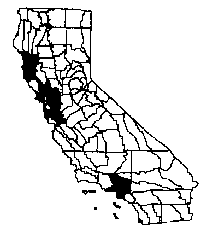
Mediterranean linseed
may be found in disturbed areas and coastal grasslands in places below 700 feet
(300 m) elevation in Mendocino County, the North Coast Ranges, the Central
Coast, and the San Francisco Bay Area (Hickman 1993; Smith and Wheelor 1990). It
can grow on serpentine. It appears to be especially abundant in wet years.
|
|
WHERE DID IT COME FROM AND HOW IS IT SPREAD?
|
Mediterranean linseed is native to the Mediterranean region from
Portugal to Turkey (Tutin et al. 1976). It spreads through dispersal of
seeds.
|
|
WHAT PROBLEMS DOES IT CAUSE?
|
This species displaces native vegetation. It parasitizes native
plants to obtain water and nutrients.
|
|
HOW DOES IT GROW AND REPRODUCE?
|
|
Mediterranean linseed is a green, photosynthetic plant, but
growth studies indicate that it must parasitize other plants for carbohydrates
in order to develop and flower (Carafa et al. 1980). It may also obtain water
and mineral salts from its host. Plants flower in spring and reproduce by
seed.
|
(click on photos to view larger image)
|
|
|
HOW CAN I GET RID OF IT?
|
|
|
Chemical control:
|
Only one article was found with information on how to control
Bellardia trixago, and it focused on control in wheat crops on marginal land in
Chile (del Pardo and Encina 1977). None of the herbicides this study found
effective are currently registered for use in rangeland or wildland situations
in California. Because of its pubescent leaves, this plant is not controlled
effectively by foliar herbicides. Del Pardo and Encina found that best results
were obtained with terbutryne + simazine + MCPA (as Agren 3614 (copyright)) at
1.5-2 kg product/ha, cyanazine + MCPA at 4.5 litres product/ha and terbutryne
(Igran 50 (copyright)) at 2 kg product/ha. Agren 3614 (copyright)åÊwas
applied at the six-leaf stage of wheat, Igran 50 (copyright)åÊat
pre-emergence and the other treatments at tillering.
No information on other control methods was
found.
|